The Best Gut Health Supplements in Australia (2026 Guide)
The gut microbiome has become one of the most researched areas in health science over the past two decades.
What was once a niche topic discussed primarily in gastroenterology clinics is now understood to be central to immune function, mental health, metabolic health, skin health, and even cardiovascular risk.
The research has been transformative and so has the market for the best gut health supplements.
The challenge for Australian consumers is that the gut health supplement market has expanded faster than the public's ability to evaluate it.
Products range from excellent, clinically validated formulas to products with genuinely no evidence behind them selling at premium prices.
This guide identifies the most evidence-supported options available in Australia in 2026, with practical guidance on choosing the right supplement for your specific situation.
Understanding the Gut Microbiome
Your gut microbiome is an ecosystem of approximately 38 trillion microorganisms, predominantly bacteria but also fungi, viruses, and archaea, living primarily in your large intestine.
A healthy microbiome is characterised by high species diversity. The greater the variety of microbial species, the more functional redundancy exists, meaning the ecosystem can maintain its core functions even when individual species populations fluctuate.
The microbiome performs an extraordinary range of functions. It ferments dietary fibre and produces short-chain fatty acids (particularly butyrate, propionate, and acetate) that serve as the primary energy source for colonocytes (the cells lining your colon), reduce inflammation, regulate immune responses, and influence metabolic rate.
It synthesises several vitamins including vitamin K and certain B vitamins. It regulates intestinal permeability, keeping the gut lining intact and preventing inflammatory compounds from entering circulation.
When this ecosystem is disrupted, the consequences extend well beyond digestive symptoms. Gut dysbiosis (an imbalanced microbiome) is associated with inflammatory bowel conditions, metabolic syndrome, type 2 diabetes, depression and anxiety, skin conditions including acne and eczema, autoimmune conditions and even cardiovascular disease.
What Disrupts Gut Health
Before addressing supplements, it is worth understanding what creates the need for gut health support in the first place. The most significant disruptors of gut microbiome health include:
- Antibiotics: Even a single standard course of broad-spectrum antibiotics can reduce gut microbial diversity by thirty to forty percent, with some studies showing disruption that persists for twelve months or longer without intervention.
- Ultra-processed food: Diets high in refined sugars, refined grains, artificial sweeteners, and emulsifiers negatively alter microbiome composition and reduce the butyrate-producing bacterial populations that are most associated with gut health.
- Chronic psychological stress: The gut-brain axis runs bidirectionally, and sustained stress activates pathways that alter gut motility, intestinal permeability, and microbial composition.
- NSAIDs (ibuprofen, aspirin, naproxen): Regular use increases intestinal permeability and disrupts the gut lining, creating an environment less hospitable to beneficial bacteria.
- Alcohol: Excessive alcohol intake reduces microbiome diversity and is associated with overgrowth of potentially harmful bacterial species in the small intestine.
- Insufficient dietary fibre: The beneficial bacteria that produce butyrate and support gut health feed almost exclusively on dietary fibre. A low-fibre diet starves these populations, leading to progressive diversity loss.
The Best Prebiotic Supplements for Gut Health
PHGG: The Best Supplement for Sensitive Guts
Partially Hydrolysed Guar Gum is the gold standard prebiotic supplement for anyone with a sensitive digestive system.
Derived from guar beans through an enzymatic hydrolysis process, PHGG is a water-soluble, low-viscosity fibre that dissolves completely in liquid, is tasteless, and is certified FODMAP Friendly and low-FODMAP by Monash University in Melbourne.
What makes PHGG exceptional as a gut health supplement is its tolerability profile.
Unlike most fibre supplements, which cause significant bloating and gas when first introduced, PHGG ferments slowly and evenly throughout the colon, producing a gradual rise in short-chain fatty acids without the rapid, uncomfortable gas production associated with inulin and FOS-based supplements.
Clinical trials have specifically demonstrated PHGG's superiority in tolerability over psyllium husk in IBS populations.
Propel Health's PHGG Powder is recommended by dietitians and bowel clinics across Australia and is particularly appropriate for people managing IBS, SIBO, functional constipation, or any digestive condition where gut health support is needed but tolerance of standard fibre supplements has been poor.
For a complete guide to this specific ingredient, see our dedicated article on PHGG as a prebiotic supplement for IBS.
Inulin for General Microbiome Support
Inulin is a chicory-derived prebiotic fibre with an excellent evidence base for supporting Bifidobacterium populations in the colon.
Bifidobacteria are among the most beneficial bacterial species in the gut microbiome and are consistently associated with healthy immune function, reduced intestinal inflammation, and protection against harmful bacterial overgrowth.
Propel Health's Organic Inulin Powder is certified organic and is a clean, single-ingredient supplement.
The important caveat is that inulin is not appropriate for people with IBS or SIBO, as its rapid fermentation rate can produce significant gas and worsen symptoms.
For people with healthy digestive systems who want to support microbiome diversity proactively, inulin is an excellent choice.
The Best Probiotic Supplements for Gut Health
Probiotic supplements add live beneficial bacteria directly to the gut. Unlike prebiotics, which feed existing bacteria, probiotics replenish or reinforce the microbial population.
The most important concept in probiotic supplementation is strain specificity: different bacterial strains produce different effects, and choosing a probiotic based on the evidence for your specific health concern is more effective than selecting on CFU count alone.•
- For general gut health maintenance: Lactobacillus acidophilus and Bifidobacterium lactis are among the most broadly beneficial strains.
- For IBS symptom reduction: Bifidobacterium longum and Bifidobacterium infantis have the strongest evidence base.
- For antibiotic recovery: Lactobacillus rhamnosus GG and Saccharomyces boulardii (a beneficial yeast) are the most evidence-supported options for restoring microbiome balance after antibiotics.
- For traveller's diarrhoea prevention: Saccharomyces boulardii again has the most robust evidence.
Combination Gut Health Supplements: Synbiotics
Combining prebiotic and probiotic supplements creates what is known as a synbiotic, and research consistently shows this combined approach outperforms either supplement alone.
The prebiotic fibre feeds and sustains the probiotic bacteria, improving their survival through the digestive tract and their ability to colonise and exert effects in the colon.
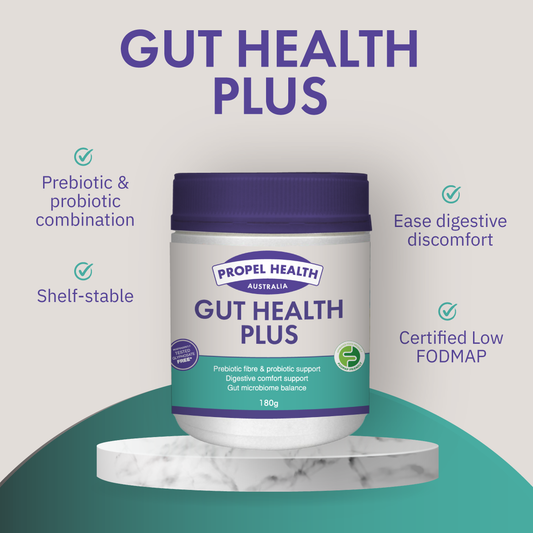
Propel Health's Gut Health Plus is formulated on this principle, combining PHGG prebiotic fibre with probiotic cultures in a single daily supplement.
There are many practitioners who consider Gut Health Plus the best prebiotic and probiotic combination in Australia.
For most people seeking comprehensive gut health support without the complexity of managing two separate products, this is the most practical option.
The prebiotic and probiotic combination (synbiotic) approach is generally more effective than either supplement alone. The prebiotic creates the environment for probiotics to thrive and produce meaningful colonisation.
The Best Supplement for Bloating
Not all bloating supplements are created equal. While some products simply aim to mask symptoms, the best bloating supplements support the digestive system itself.
When choosing a bloating supplement, look for ingredients that help:
- Support healthy bowel regularity
- Soothe the digestive tract
- Nourish beneficial gut bacteria
- Support the gut lining
- Promote long-term digestive comfort rather than temporary relief
Ingredients such as psyllium husk, slippery elm bark, organic inulin, yucca root and sunflower lecithin each support different aspects of digestive health.
Together, they provide a more comprehensive approach rather than relying on a single ingredient.
If you're looking for additional digestive support, explore our best supplements for gut health and bloating, formulated with carefully selected fibres and botanical ingredients to support digestive comfort, bowel regularity and a healthy gut microbiome as part of a balanced diet.
Or read our complete guide: Best Bloating Supplement: What to Look For Before You Buy.
Supplements That Support Gut Health
Several vitamins and nutritional supplements beyond conventional prebiotics and probiotics meaningfully support gut health:
Collagen
Increasingly, health practitioners are recommending collagen for gut repair following a recent study showing 93% of women who supplemented with 20g of collagen per day improved their symptoms, including bloating.
Zinc
Zinc plays a critical role in maintaining intestinal barrier function. Zinc deficiency is associated with increased intestinal permeability (leaky gut), impaired gut immune function, and reduced production of digestive enzymes.
Zinc carnosine has been studied specifically in relation to the gut lining. That is research into a mechanism, not a claim about what a supplement will do for you.
Vitamin D
Vitamin D receptors are present throughout the gastrointestinal tract, and vitamin D deficiency is strongly associated with increased intestinal permeability, dysbiosis, and heightened gut inflammatory responses.
Adequate vitamin D is necessary for the normal function of tight junction proteins that seal the gut lining.
Magnesium
Magnesium is involved in smooth muscle function throughout the GI tract and plays a role in regulating bowel motility.
Many people with constipation find that magnesium supplementation significantly improves regularity by drawing water into the colon and supporting peristaltic muscle function.
How to Choose the Right Gut Health Supplement for Your Situation
Use this framework to match your situation to the most appropriate supplement:
- IBS (either constipation-predominant or diarrhoea-predominant): Start with PHGG powder, which is FODMAP-Friendly certified and specifically studied in this population.
- After a course of antibiotics: Take both a probiotic and PHGG to restore and sustain microbiome diversity.
- General health maintenance with no digestive issues: Either inulin or a combined prebiotic-probiotic supplement like Gut Health Plus.
- Constipation as the primary concern: Both PHGG and magnesium supplementation have evidence for improving constipation, working through different mechanisms that can complement each other.
- Bloating as the primary concern: Choose PHGG over inulin, as inulin's faster fermentation rate is more likely to worsen rather than improve bloating symptoms initially.
For a comparison of how prebiotics and probiotics differ and how to choose between them, see our guide to prebiotics vs probiotics for gut health.
For a broader wellness supplementation framework, see our article on how to build a supplement routine that actually works.
About the Author
Grant Jenkins is the founder of Propel Health Australia and a high-performance coach & physiologist with over 25 years’ experience working with elite and developing athletes. He has formulated nutritional supplements used by athletes, families and health professionals across Australia. Grant combines real-world coaching experience with evidence-based research to bridge the gap between performance science and practical health.
Disclaimer
Propel Health offers this article for education purposes only. Please consult your Health Practitioner for personalised and specific information.
For the detail on one of them, see the benefits of psyllium husk powder.