Protein for Older Athletes: How Much, How Often and From What
More on: Whey Protein Isolate Guides
TL;DR: Protein for older athletes is about the dose per meal as much as the daily total: aim for around 1.6 g per kilogram of body weight a day, spread as roughly 30 to 40 g across three or four meals. Older muscle needs a bigger serve each time than younger muscle does. Get it from food first, and use a protein powder only to fill the gap at the meal that falls short.
Most masters athletes I meet think they eat plenty of protein.
Then we count it.
Breakfast is toast and coffee. Lunch is a salad. All the protein lands at dinner.
That pattern costs older athletes more than it costs younger ones.
How much protein older athletes need
A 2018 meta-analysis of 49 trials by Morton and colleagues found gains from resistance training levelled off around 1.6 g of protein per kilogram of body weight per day.
For a 75 kg athlete, that is about 120 g a day.
Your action: track your protein for three normal days before changing anything.
Why the dose per meal matters after 40
A study by Moore and colleagues found older men needed about 0.4 g of protein per kilogram at a meal to get the same response younger men got from about 0.24 g.
So a 15 g breakfast that works at 25 may do very little at 55.
Your action: aim for 30 to 40 g at each main meal, not 10 at breakfast and 70 at dinner.
Masters athlete nutrition: a sample day
- Breakfast: three eggs, Greek yoghurt and toast. About 35 g.
- Lunch: chicken, rice and vegetables. About 40 g.
- Afternoon: tuna on crackers, or a protein smoothie. About 25 g.
- Dinner: fish or lean beef, potato and salad. About 40 g.
That is around 140 g without trying very hard.
Your action: fix breakfast first. It is where most older athletes fall short.
Where a protein powder fits
Food first. A powder is just a convenient way to fill the meal that keeps falling short.
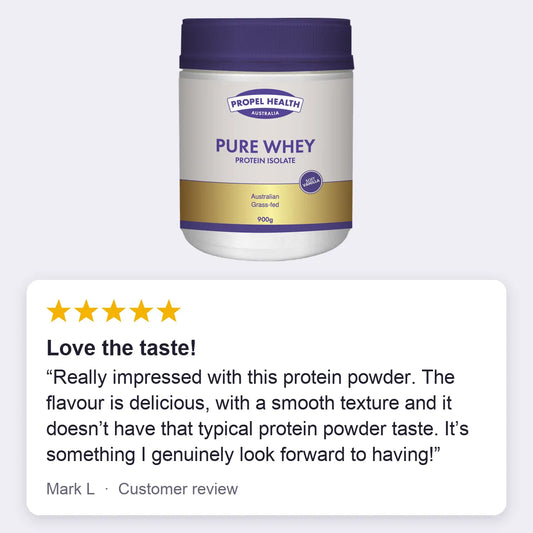
Our whey protein isolate is Australian grass-fed native whey with natural vanilla and organic stevia: 30 g per serve gives 25.1 g of protein. It contains milk.
Your action: if breakfast is the gap, blend a scoop into oats or a smoothie.
Is collagen protein?
It counts toward your total, but it is low in leucine, the amino acid that matters most for muscle. Treat collagen as an extra for connective tissue, not as a main protein meal. More in collagen for athletes.
For joints, a formula is the other route. Ours is Complete Joint Care, which also contains 2.3 g of protein per 5 g serve. Each 5 g serve provides 40 mg of vitamin C, which contributes to normal collagen formation for the normal structure of cartilage and bones. It also provides zinc, which contributes to the maintenance of normal bones.
Your action: keep collagen or a joint formula separate from your protein maths.
The rest of the list
Protein is step two of four. The full order is in supplements for masters athletes, and if you lift, read creatine for older athletes.
Your action: get protein right for a month before adding anything else.
If you are on medication, carrying an injury or have a medical condition, speak with your healthcare provider before starting any new supplement.
Grant Jenkins is an ESSA Accredited Exercise Physiologist and high-performance athletic development coach with almost 30 years of coaching behind him, including national academy and professional athletes. He is a co-founder of Propel Health Australia.
References
- Morton RW, Murphy KT, McKellar SR, et al. Br J Sports Med. 2018;52(6):376-384.
- Moore DR, Churchward-Venne TA, Witard O, et al. J Gerontol A Biol Sci Med Sci. 2015;70(1):57-62.