What Is the Difference Between Native Whey & Whey Isolate?
More on: Whey Protein Isolate Guides
TL;DR: What is the difference between native whey and whey isolate? Native whey is extracted directly from milk before cheese production, while whey isolate is highly filtered to concentrate the protein and remove much of the fat and lactose. Research suggests that native whey may offer advantages in protein utilisation and muscle strength. Propel Health Australia's Pure Whey Protein Isolate combines native whey, Australian grass-fed dairy and a simple three-ingredient formula.
If you've been comparing protein powders, you've probably noticed terms like native whey, whey concentrate, whey isolate and hydrolysed whey.
Protein quality matters. But understanding what you're buying matters just as much.
Native whey and whey isolate describe two different things.
One tells you how the protein was extracted. The other tells you how concentrated it is.
You don't necessarily have to choose between them.
You can have both.
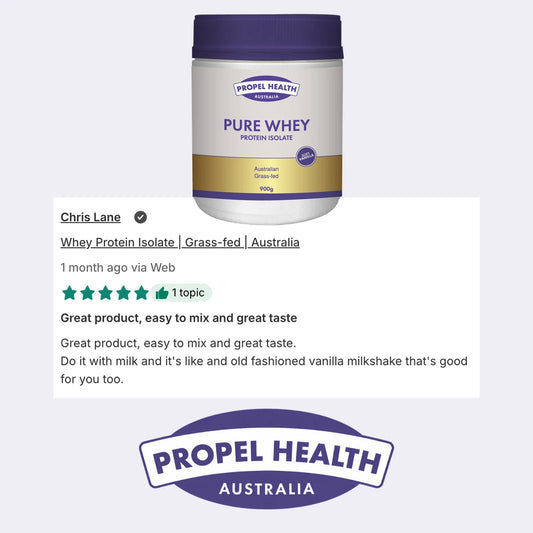
And that's exactly what we've done with our Australian grass-fed whey protein isolate.

What Is the Difference Between Native Whey and Whey Isolate?
The simplest way to understand the difference is to look at how whey protein is produced.
What Is Native Whey Protein?
Native whey protein is extracted directly from milk, before the cheese-making process.
Cow's milk naturally contains two main groups of proteins:
- Approximately 80% casein
- Approximately 20% whey protein
Traditionally, whey protein is obtained as a by-product of cheese production. The milk is coagulated, separating the curds from the liquid whey.
Native whey takes a different approach.
The whey proteins are separated directly from milk using membrane filtration, before the milk undergoes cheese production.
This process can use low temperatures to limit heat exposure during extraction.
The result is whey protein obtained directly from milk rather than from the liquid remaining after cheese-making.
The important distinction is how the protein is sourced and processed.
What Is Whey Protein Isolate?
Whey protein isolate, commonly called WPI, is a concentrated form of whey protein.
It undergoes filtration to remove much of the lactose, fat and other non-protein components.
The result is a protein ingredient that typically contains around 90% protein or more on a dry basis.
Whey protein isolate provides:
- All nine essential amino acids
- Naturally occurring branched-chain amino acids (BCAAs)
- Leucine, an amino acid involved in muscle protein synthesis
- High protein concentration
- Relatively little fat and lactose
Whey isolate can be produced from conventional cheese-derived whey or directly from milk.
So when you see a product described as native whey protein isolate, it means you're getting both characteristics.
Native extraction and isolate-level protein concentration.
Native Whey vs Whey Isolate: Comparison
| Feature | Native whey | Whey protein isolate |
|---|---|---|
| What it describes | How whey is extracted | How concentrated the protein is |
| Extraction | Directly from milk | Can be milk-derived or cheese-derived |
| Protein concentration | Depends on further processing | Typically around 90% or more in the dry isolate ingredient |
| Lactose | Depends on filtration | Generally low |
| Fat | Depends on filtration | Generally low |
| Essential amino acids | Complete protein | Complete protein |
| Leucine | Naturally present | Naturally present |
| Can be both native and isolate? | Yes | Yes |
Here's the important point.
Native whey isn't automatically whey isolate, and whey isolate isn't automatically native.
A native whey concentrate may contain more fat and lactose than a conventional whey isolate.
But native whey protein isolate combines direct-from-milk extraction with the high protein concentration of WPI.
That's the combination we wanted for Propel Health Australia.
Is Native Whey Better Than Whey Isolate?
Both native whey and conventional whey isolate provide complete protein.
Both contain leucine and the other essential amino acids needed for muscle protein synthesis.
But does the way whey is produced make a difference?
There's emerging research suggesting it may.
What Does the Research Say About Native Whey Protein?
A 2023 study by Kim and colleagues, published in Food Science and Biotechnology, compared native whey protein with conventional cheese-derived whey protein over eight weeks.
The researchers examined protein utilisation, lean mass and muscle strength in rats consuming equal amounts of protein.
The native whey was extracted directly from milk using low-temperature filtration. The conventional whey was obtained during cheese production and underwent heating and spray-drying.
The results were interesting.
| Measurement | Native whey compared with conventional whey |
|---|---|
| Lean mass | 5.4% higher |
| Grip strength after eight weeks | Approximately 9% higher |
| Soleus muscle weight | 15.65% higher |
| Plantaris muscle weight | 7.3% higher |
| Biological value | 95.94% vs 92.81% |
| Net protein utilisation | 93.13% vs 90.17% |
The differences were statistically significant.
The researchers also found that native whey had higher biological value and net protein utilisation, despite both proteins having similarly high true digestibility.
In other words, the difference wasn't simply how much protein was digested. The native whey group retained and utilised a greater proportion of dietary protein.
This is an important distinction when considering protein quality.
The researchers concluded that native whey produced with minimal heat exposure may offer advantages in protein utilisation, muscle mass and strength.
The results suggest that how whey protein is processed deserves attention alongside the amount of protein on the nutrition panel.
Why Protein Processing Matters
Protein isn't just a number on a label.
The way milk proteins are processed can influence their physical structure and functional properties.
Heat exposure, filtration and drying methods can all affect the characteristics of the finished protein ingredient.
This doesn't mean that conventional whey protein is poor quality.
It means that two products with similar protein percentages may have undergone quite different production processes.
That's a good reason to ask more questions about where a whey protein comes from and how it's made.
Not just how many grams of protein are in a scoop.
Why We Chose Australian Grass-Fed Native Whey Protein Isolate
When we developed Propel Health Australia's Pure Whey Protein Isolate, we wanted to keep things straightforward.
A high-quality protein source.
Australian dairy.
A simple ingredient list.
And a product people would actually enjoy using every day.
There are three characteristics worth understanding.
1. Native Whey Extracted Directly From Milk
Our Pure Whey uses native whey protein isolate.
That means the whey protein is extracted directly from milk rather than collected as a by-product of cheese production.
The direct-from-milk approach is one of the reasons we chose native whey.
As the 2023 research suggests, differences in whey processing may matter when evaluating protein quality.
2. Australian Grass-Fed Dairy
Our whey protein comes from Australian grass-fed dairy.
Why does that matter?
Because ingredient origin and traceability are important considerations when choosing a supplement.
The term grass-fed describes the dairy source. It doesn't automatically guarantee greater muscle growth or a superior amino acid profile.
But it does tell you something about where your protein comes from.
And that's information we believe customers should have.
3. Whey Protein Isolate
Our protein isn't simply native whey.
It's native whey isolate.
The additional filtration produces a protein ingredient containing more than 90% protein on a dry basis, with much of the lactose and fat removed.
That gives us a concentrated protein source suitable for a straightforward daily protein powder.
What's in Propel Health Australia's Pure Whey Protein Isolate?
We wanted a protein powder without an unnecessarily complicated ingredient list.
Our Pure Whey Protein Isolate contains just three ingredients:
- Australian grass-fed native whey protein isolate
- Natural vanilla flavour
- Organic stevia
No artificial colours, flavours or sweeteners.
The finished powder has a light vanilla flavour and can be mixed into water, milk, yoghurt, oats or smoothies.
Pure Whey Protein Isolate Nutrition
| Nutrient | Per 30 g serve |
|---|---|
| Protein | 25.1 g |
| Carbohydrate | 2.8 g |
| Sugars | 1.4 g |
| Fat | 0.06 g |
| Dietary fibre | 0.7 g |
That works out to approximately 83.7 g of protein per 100 g of finished powder.
It's worth understanding the difference between the raw isolate ingredient and the finished flavoured product.
The native whey isolate ingredient contains more than 90% protein on a dry basis.
Once natural vanilla flavour and organic stevia are included, the finished powder has a slightly lower protein percentage.
That's normal.
When comparing protein powders, always check the nutrition panel of the product you're actually buying.
Does Native Whey Have More Leucine?
Leucine is an essential amino acid involved in stimulating muscle protein synthesis.
It's one of the reasons whey protein is widely used in sports nutrition.
Both native whey and conventional whey isolate naturally contain leucine.
Some native whey products may have differences in amino acid composition or the rate at which amino acids appear in the blood.
However, these differences vary between products and processing methods.
Interestingly, the 2023 study by Kim and colleagues found no significant difference in blood leucine concentrations between the native and conventional whey groups, despite differences in muscle mass and strength.
That suggests the findings cannot be explained simply by higher circulating leucine.
The practical takeaway?
Look at the overall quality of the protein, not just one amino acid.
How to Choose a Quality Whey Protein Powder
I've worked with athletes across different sports and levels of performance for almost 30 years.
One lesson that applies just as much to everyday nutrition as high-performance sport is that more complicated doesn't necessarily mean better.
When comparing whey protein powders, I'd look at five things.
1. Protein Source
Is the product whey concentrate, whey isolate or a blend?
If you're looking for a high-protein, low-fat option, whey isolate is worth considering.
2. Native or Conventional Extraction
Is the whey extracted directly from milk, or obtained during cheese production?
Both can provide quality protein, but the production methods are different.
Research suggests those differences may be worth considering.
3. Milk Origin
Where does the milk come from?
If Australian grass-fed dairy matters to you, check the source of the protein ingredient.
An Australian supplement company doesn't necessarily use Australian dairy.
4. Protein Per 100 g
Don't compare protein powders using scoop sizes alone.
One brand might use a 25 g serve, another 30 g and another 40 g.
Comparing protein per 100 g gives you a more consistent measure.
5. Ingredients
Read the full ingredient list.
Some products contain additional ingredients for flavour, texture or specific nutritional purposes.
Others keep things simple.
Our Pure Whey Protein Isolate uses just three ingredients.
If you're looking for a straightforward protein supplement, that's a useful place to start.
Who Should Use Native Whey Protein Isolate?
Native whey protein isolate is a convenient source of complete protein for women, adults over 35, busy people and anyone who wants to maintain muscle mass and meet their daily protein requirements.
Women Who Want to Maintain Muscle and Strength
Protein isn't just for people lifting heavy weights at the gym.
For women, adequate protein intake is important for maintaining muscle mass, supporting an active lifestyle and meeting everyday nutritional needs.
Whether you're juggling work and family, returning to exercise or starting strength training, whey protein isolate can make it easier to include enough protein throughout the day.
Adults Over 35
As we get older, maintaining muscle mass and strength becomes increasingly important.
From our mid-30s onwards, it's worth paying closer attention to both resistance exercise and daily protein intake, particularly as we move into our 40s, 50s and beyond.
Native whey protein isolate provides all nine essential amino acids, including leucine, which plays an important role in muscle protein synthesis.
Combined with regular strength training, adequate protein intake helps support the maintenance and development of muscle mass.
Busy People Who Struggle to Eat Enough Protein
Not everyone has time to prepare a protein-rich breakfast or lunch every day.
Between work, family and other commitments, it's easy for protein intake to become an afterthought.
A whey protein isolate shake provides a convenient option when you're short on time.
Add it to a morning smoothie, stir it into yoghurt or blend it with milk for an easy protein-containing snack.
Strength and Endurance Athletes
Athletes have additional protein requirements depending on their training load, body weight and goals.
For strength-training athletes, adequate protein intake works alongside resistance training to support muscle protein synthesis and muscle development.
For runners, cyclists, swimmers and other endurance athletes, protein is important for maintaining muscle and supporting adaptation to regular training.
Native whey protein isolate offers a concentrated source of complete protein that can be incorporated into meals or consumed after exercise.
The bottom line: You don't have to be an athlete to benefit from adequate protein. If you're already meeting your requirements through food, you may not need a supplement. But if you're falling short, native whey protein isolate can be a simple, convenient way to close the gap.
When Should You Take Native Whey Protein Isolate?
For most people, there's no need to overcomplicate protein timing.
You can take whey protein isolate:
- At breakfast
- After training
- Between meals
- In a smoothie
- Mixed into yoghurt or oats
Your total daily protein intake is generally more important than consuming a shake at one exact time.
If you're training regularly, distributing protein across your meals can also be a practical approach.
For most people, consistency matters more than finding the perfect supplement routine.
Frequently Asked Questions
Is Native Whey the Same as Whey Isolate?
No.
Native whey describes protein extracted directly from milk before cheese production. Whey isolate describes protein that has undergone filtration to achieve a high protein concentration. A product can be both native and isolate.
Is Native Whey Better for Muscle Growth?
A 2023 study suggests consuming native whey may have a greater gain in lean mass and grip strength than conventional whey.
These findings are promising, but they don't establish that native whey produces greater muscle growth.
Is Native Whey Protein Isolate Better Than Whey Concentrate?
Native whey isolate generally contains more protein and less lactose and fat than whey concentrate. The right choice depends on your dietary needs, preferences and budget.
Is Native Whey Easier to Digest?
Not necessarily. Digestive tolerance depends on lactose content, individual tolerance and the finished formulation. Whey isolate generally contains less lactose than whey concentrate, whether it is native or conventional.
Is Australian Grass-Fed Whey Protein Better?
Australian grass-fed whey offers a clearly identified dairy source. Grass-fed production doesn't automatically mean greater muscle-building effects, but sourcing, traceability and ingredient transparency are useful considerations when choosing protein.
Can You Take Native Whey Protein Isolate Every Day?
Yes. For most healthy adults, whey protein isolate can be used daily as part of a balanced diet. The amount required depends on your overall protein intake, activity level and individual needs.
Does Native Whey Protein Contain Lactose?
Native whey can contain lactose, depending on how it's processed. Native whey protein isolate generally contains much less lactose than native whey concentrate, although it should not automatically be considered lactose-free.
What Is the Difference Between Native Whey and Whey Isolate? The Take-Home Message
Native whey and whey isolate aren't competing categories.
Native describes how the whey is extracted. Isolate describes how concentrated the protein is.
You can have one without the other.
Or you can have both.
And there's emerging research suggesting that the way whey protein is processed may influence protein utilisation and muscle outcomes.
That's one reason we chose native whey protein isolate for Propel Health Australia.
We combined it with Australian grass-fed dairy and kept the finished product to three ingredients.
No unnecessary complexity.
Just a straightforward protein powder with a clearly identified source.
Buy Australian Grass-Fed Native Whey Protein Isolate
If you're looking for a native whey protein isolate in Australia, our Pure Whey Protein Isolate brings together:
- Australian grass-fed dairy
- Native whey extracted directly from milk
- High-protein whey isolate
- 25.1 g of protein per 30 g serve
- Natural vanilla flavour
- Organic stevia
- No artificial colours, flavours or sweeteners
Buy Propel Health Australia's Pure Whey Protein Isolate
References
Kim J, Jeong EW, Baek Y, Go GW, Lee HG. Comparison of the effects of commercial whey protein and native whey protein on muscle strength and muscle protein synthesis in rats. Food Science and Biotechnology. 2023;32(3):381–388. doi:10.1007/s10068-023-01248-7.
About the Author
Grant Jenkins is the co-founder of Propel Health Australia and an ESSA Accredited Exercise Physiologist with almost 30 years of experience in high-performance athletic development. He has worked with athletes competing at World Championships and all four tennis Grand Slams. His approach to nutrition combines scientific research with practical experience helping athletes and everyday Australians build sustainable habits.
This article provides general nutrition education and is not a substitute for individual advice from a qualified health practitioner.