Creatine for Older Athletes: Dose, Timing and What to Expect
More on: Creatine Guides
TL;DR: Creatine for older athletes is one of the best-researched supplements there is: in adults over 50, creatine taken alongside resistance training added more lean mass and strength than training alone. Take 3 to 5 g of plain creatine monohydrate every day, no loading needed, and pair it with two strength sessions a week. Expect a small rise on the scales in the first weeks from water held in muscle.
Most people think creatine is for 22-year-olds in a weights room.
The research says the people who may get the most from it are older.
Here is why, and how to use it.
What creatine does
Your muscles store creatine as phosphocreatine, a fast fuel for short, hard efforts.
Supplementing tops those stores up, which lets you do a little more work in each set. Over months, that extra work adds up.
Your action: think of creatine as a daily habit, like protein, not a pre-workout.
What the research shows in older athletes
A 2017 meta-analysis by Chilibeck and colleagues pooled trials in adults over 50 and found creatine with resistance training produced greater gains in lean tissue and strength than resistance training alone.
Candow and colleagues have reviewed the same question several times and reached the same conclusion: it works when it is paired with training.
Your action: book your strength sessions first. Creatine amplifies training; it does not replace it.
How much creatine for older athletes
- 3 to 5 g a day, every day, including rest days.
- No loading phase needed.
- Any time of day you will remember.
- Plain creatine monohydrate: the form used in almost all the research.
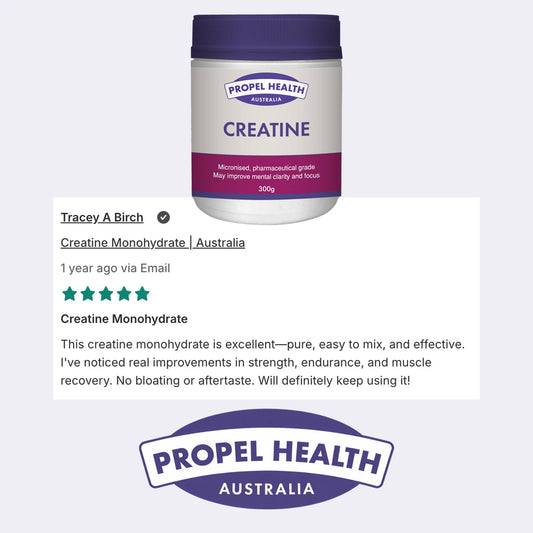
Our creatine monohydrate is one heaped teaspoon (5 g) per serve, 60 serves a tub, nothing else in it.
Your action: stir it into the same drink every morning.
Water weight and competing
Creatine pulls water into muscle, so the scales may rise by around a kilo in the first weeks.
If you race in a weight class, or carry yourself for hours in endurance events, start in the off-season. Creatine is not on the World Anti-Doping Agency prohibited list.
Your action: weigh yourself on the same morning each week for a month and note the trend.
Creatine is for muscle, not joints
Creatine supports the muscle side. It does nothing directly for tendons, ligaments or cartilage, which is where many masters athletes get stopped.
That is why it makes sense to pair it with collagen or a joint formula. Ours is Complete Joint Care: collagen, glucosamine, chondroitin and MSM in one 5 g scoop.
Sport-specific detail: creatine for BJJ over 40 and strength training for triathletes over 40. The full list is in supplements for masters athletes.
Your action: one glass, two scoops, every morning.
If you are on medication, carrying an injury or have a medical condition, speak with your healthcare provider before starting any new supplement.
Grant Jenkins is an ESSA Accredited Exercise Physiologist and high-performance athletic development coach with almost 30 years of coaching behind him, including national academy and professional athletes. He is a co-founder of Propel Health Australia.
References
- Chilibeck PD, Kaviani M, Candow DG, Zello GA. Open Access J Sports Med. 2017;8:213-226.
- Candow DG, Forbes SC, Chilibeck PD, et al. J Clin Med. 2019;8(4):488.
- Kreider RB, Kalman DS, Antonio J, et al. J Int Soc Sports Nutr. 2017;14:18.