Prebiotics vs Probiotics: Which Gut Health Supplement Do You Need?
Prebiotics and probiotics are frequently mentioned in the same breath, promoted on the same supplement shelves, and often confused with each other.
While both contribute to a healthy gut microbiome, they work through fundamentally different mechanisms and are appropriate for different situations.
Understanding the distinction is essential for choosing the supplement that will actually address your specific gut health concerns.
This guide provides a clear, evidence-based comparison of prebiotics and probiotics, explains when each is most useful, and gives practical guidance on when combining both provides the most comprehensive gut health support.
The Gut Microbiome: A Brief Foundation
The human gut microbiome contains an estimated 38 trillion microorganisms, the vast majority of which are bacteria residing in the large intestine. This complex ecosystem performs functions that are critical to health: fermenting dietary fibre to produce short-chain fatty acids, synthesising vitamins including K2 and several B vitamins, regulating intestinal immune responses, maintaining the integrity of the gut lining, and communicating with the central nervous system via the gut-brain axis.
A healthy microbiome is diverse and stable. It contains a wide range of bacterial species (diversity) and maintains that composition consistently over time (stability). Both diversity and stability are threatened by the factors common in modern life: antibiotic use, low-fibre diets, chronic stress, excess alcohol, and overuse of NSAIDs.
Both prebiotic and probiotic supplements exist to support and restore microbiome health, but they address different aspects of the problem.
What Are Prebiotic Supplements?
Prebiotics are non-digestible food compounds that selectively stimulate the growth and activity of beneficial bacteria already present in the gut.
The most commonly used definition, established by Gibson and Roberfroid and refined by the International Scientific Association for Probiotics and Prebiotics, requires that a compound be resistant to gastric digestion, fermented by gut microbiota, and result in selective stimulation of the growth or activity of specific beneficial bacteria.
In practice, most prebiotic supplements are forms of soluble dietary fibre that reach the large intestine intact and serve as fermentable substrate for beneficial bacterial populations.
The fermentation of prebiotic fibre by Bifidobacterium, Lactobacillus, Faecalibacterium prausnitzii, and other beneficial species produces short-chain fatty acids that nourish the gut lining, reduce inflammation and modulate immune responses.
The Main Types of Prebiotic Supplements
The most researched and commonly used prebiotic supplements include:
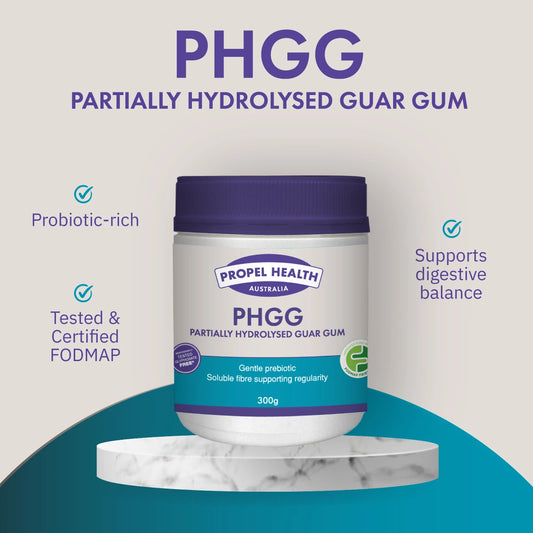
- PHGG (Partially Hydrolysed Guar Gum): Water-soluble, FODMAP-friendly certified, gentle fermentation profile, specifically validated for IBS.
- Inulin and FOS (Fructooligosaccharides): Chicory-derived, strong evidence for Bifidobacterium stimulation, faster fermentation rate that can cause bloating in sensitive individuals.
- GOS (Galactooligosaccharides): Found naturally in legumes and dairy, good evidence for Bifidobacterium and Lactobacillus stimulation, commonly included in infant formula.
- Beta-glucan: Found naturally in oats and mushrooms, well-studied for immune-modulating effects via gut microbiome stimulation.
- Resistant starch: Found in cooled cooked potatoes, green bananas, and legumes, fermented by butyrate-producing bacteria associated with gut lining health.
What Are Probiotic Supplements?
Probiotics are live microorganisms that, when consumed in adequate amounts, confer a health benefit on the host.
This is the definition established by the World Health Organisation and used by researchers and regulatory bodies globally.
The key elements are that the organisms must be alive, present in sufficient numbers, and demonstrably beneficial.
Unlike prebiotics, which work by feeding bacteria already in your gut, probiotics introduce new bacterial (or yeast) strains from outside.
These live organisms must survive the acid environment of the stomach and bile salts in the small intestine in sufficient numbers to reach the large intestine and exert their effects.
Most probiotic strains do not permanently colonise the gut.
Research indicates that supplemental probiotic strains typically remain in the gut for days to weeks after supplementation stops.
This is why consistent daily probiotic supplementation is required to maintain their presence and effects, rather than a finite course producing lasting change.
The Most Important Probiotic Strains and Their Evidence
- Lactobacillus rhamnosus GG: One of the most studied probiotic strains globally. Strong evidence for preventing antibiotic-associated diarrhoea, managing childhood and adult acute diarrhoea, and reducing the duration of gut infections.
- Bifidobacterium longum: Well-evidenced for reducing IBS symptom severity, managing constipation, and supporting immune function in older adults.
- Lactobacillus acidophilus: Broad general gut health support, involved in lactose digestion, and commonly included in general gut health formulas.
- Saccharomyces boulardii: A probiotic yeast rather than a bacterium. The strongest evidence for antibiotic-associated diarrhoea prevention, traveller's diarrhoea, and Clostridium difficile recurrence prevention. Unusually robust because it is not killed by the antibiotics that disrupt bacterial probiotics.
- Bifidobacterium infantis: Specific evidence for IBS symptom reduction, including abdominal pain, bloating, and bowel habit normalisation.
Head-to-Head: Prebiotic vs Probiotic for Different Situations
After a Course of Antibiotics
Probiotics are the first-line supplement recommendation here, particularly Saccharomyces boulardii and Lactobacillus rhamnosus GG, both of which have robust evidence for reducing antibiotic-associated diarrhoea and accelerating microbiome recovery.
However, combining a probiotic with a prebiotic supplement creates a significantly more powerful recovery protocol, as the prebiotic supports the survival and growth of both the supplemented probiotic strains and native beneficial bacteria that survived the antibiotic course.
Managing IBS
For IBS management, the evidence strongly favours starting with PHGG prebiotic fibre, particularly given its FODMAP-Friendly certification and its specific clinical validation in IBS populations.
Some IBS patients also benefit from specific probiotic strains, particularly those targeting the diarrhoea-predominant or pain-predominant subtypes.
A trial of PHGG Powder alone for six to eight weeks before adding a probiotic is a reasonable approach that allows you to identify the effect of each component separately.
General Wellness and Microbiome Maintenance
For people without specific digestive conditions who simply want to maintain a healthy microbiome, a combined prebiotic and probiotic approach in the form of a synbiotic supplement is the most practical choice. Propel Health's Gut Health Plus delivers this combination in a single daily formula.
Immune Support
Both prebiotic and probiotic supplements support immune function through their effects on the gut-associated lymphoid tissue (GALT), which comprises approximately seventy percent of the entire immune system.
Prebiotic supplements support this function by providing the fermentable substrate that drives short-chain fatty acid production and maintains gut barrier integrity.
Probiotic supplements interact directly with intestinal immune cells and stimulate immune regulatory responses.
There is no universal winner between prebiotics and probiotics. The right supplement depends on your specific situation, your digestive history, and your health goals. For most people, a combination of both provides the most comprehensive support.
The Case for Combining Both: Synbiotics
Research comparing prebiotic-only, probiotic-only, and synbiotic (combined) interventions consistently finds the synbiotic approach produces the most significant improvements in microbiome diversity, short-chain fatty acid production, and gut-related health markers.
The mechanism is intuitive: probiotic bacteria introduced into an environment rich in prebiotic substrate (food) survive better, colonise more effectively, and produce more of their beneficial metabolites than probiotic bacteria introduced into a gut without adequate prebiotic support.
For practical daily use, Propel Health's Gut Health Plus combines PHGG prebiotic fibre with probiotic cultures in a single supplement. For people who want more flexibility in their approach or who have specific strain requirements, combining standalone PHGG Powder with a separately chosen probiotic supplement allows for more targeted customisation.
For a detailed guide to PHGG specifically, see our article on PHGG: the dietitian-recommended prebiotic fibre for IBS. For a broader overview of gut health supplement options, see our complete guide to the best gut health supplements in Australia.
About the Author
Grant Jenkins is the founder of Propel Health Australia and a high-performance coach & physiologist with over 25 years’ experience working with elite and developing athletes. He has formulated nutritional supplements used by athletes, families and health professionals across Australia. Grant combines real-world coaching experience with evidence-based research to bridge the gap between performance science and practical health.
Disclaimer
Propel Health offers this article for education purposes only. Please consult your Health Practitioner for personalised and specific information.