Prebiotics vs Probiotics for Gut Health
TL;DR Prebiotics vs probiotics for gut health comes down to one distinction: prebiotics are fibre that feeds the bacteria already living in your gut, probiotics are live bacteria you swallow. Prebiotics work on the garden, probiotics add plants. Most people do best with both.
Prebiotics vs probiotics for gut health is the question we get asked most, and the two get confused constantly because they sit on the same shelf and sound almost identical. They are not the same thing and they do not do the same job.
Prebiotics vs Probiotics for Gut Health: The Short Answer
| Prebiotics | Probiotics | |
|---|---|---|
| What it is | Non-digestible fibre | Live microorganisms |
| How it works | Feeds the beneficial bacteria you already have | Introduces bacteria from outside |
| Is it alive? | No | Yes, and it has to stay alive to work |
| Needs refrigeration? | No | Usually, unless the strain is spore forming |
| Shelf life | Long and stable | Declines over time |
| Survives stomach acid? | Yes, it is fibre | Only some strains, in useful numbers |
| Typical form | Powder | Capsule, powder or fermented food |
| Common examples | PHGG, inulin, FOS, GOS, resistant starch | Lactobacillus, Bifidobacterium, Bacillus coagulans |
The simplest way to hold it: prebiotics tend the soil, probiotics plant seeds. Planting into poor soil is the reason a lot of people take a probiotic and notice nothing.
What Are Prebiotics?
Prebiotics are non-digestible food compounds that selectively feed beneficial bacteria already present in the gut.
To qualify as a prebiotic under the definition used by the International Scientific Association for Probiotics and Prebiotics, a compound has to be resistant to digestion in the stomach, fermented by gut microbiota, and selectively stimulate beneficial bacteria rather than feeding everything indiscriminately.
In practice most prebiotic supplements are soluble dietary fibres that reach the large intestine intact. Bacteria there ferment them and produce short-chain fatty acids, which are the compounds most of the research interest sits on.
The main types of prebiotic
- PHGG (Partially Hydrolysed Guar Gum): water soluble, dissolves without thickening, ferments slowly, and is FODMAP Friendly Certified, which is why dietitians working with a low FODMAP protocol reach for it.
- Inulin and FOS: chicory derived, strong evidence for feeding Bifidobacterium, but ferments faster, which some people notice as gas.
- GOS: found in legumes and dairy, commonly added to infant formula.
- Beta-glucan: from oats and mushrooms.
- Resistant starch: cooled cooked potato, green banana, legumes.
What Are Probiotics?
Probiotics are live microorganisms that, taken in adequate amounts, confer a benefit on the host. That is the World Health Organisation definition, and the three conditions inside it matter: alive, in sufficient numbers, and demonstrably useful.
Unlike prebiotics, probiotics introduce new strains from outside. Those organisms have to survive stomach acid and bile salts in large enough numbers to matter by the time they arrive.
Most strains do not permanently colonise. Research indicates supplemental strains typically persist for days to weeks after you stop taking them, which is why probiotics are a daily habit rather than a course you finish.
Why spore forming strains are different
Some probiotics, Bacillus coagulans among them, form a protective spore. That coat survives heat, moisture and stomach acid, so no refrigeration is needed and the count on the label is closer to the count you actually get. See bacillus coagulans benefits for the detail.
Which One Should You Take?
If your fibre intake is low
Start with a prebiotic. Most Australians do not reach the recommended daily fibre target, and adding bacteria to a gut with nothing to ferment is doing the second step before the first.
After a course of antibiotics
This is where people most commonly reach for a probiotic, and taking a prebiotic alongside it gives both the new strains and your surviving native bacteria something to work with.
If your digestion is sensitive
Fermentation speed is what usually causes trouble, not fibre itself. A slow fermenting, FODMAP Friendly Certified option like PHGG is the gentler starting point. Introduce it at half a serve for the first week.
For everyday maintenance
A combined product is the practical answer, because it is one powder and one habit rather than two.
Prebiotics and Probiotics Together: Synbiotics
A supplement containing both is called a synbiotic.
The logic is straightforward: bacteria introduced into a gut that already has fermentable fibre available have something to eat on arrival. Research comparing prebiotic only, probiotic only and combined approaches generally favours the combination on measures of microbiome diversity and short-chain fatty acid production.
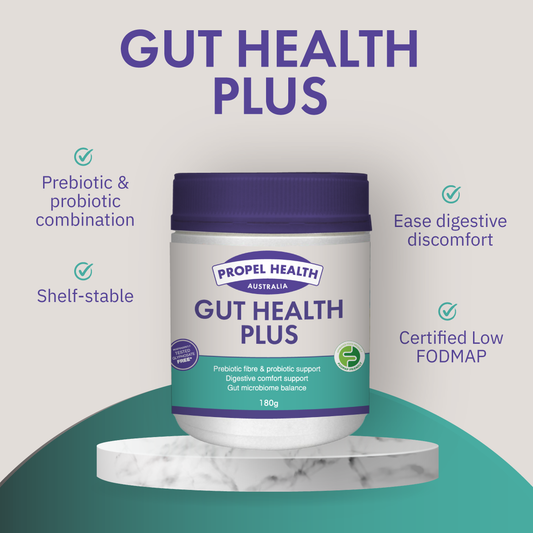
Propel Health Gut Health Plus combines PHGG with Bacillus coagulans MTCC 5856 in one daily powder. If you would rather keep them separate and choose your own probiotic, PHGG powder on its own is the prebiotic half.
Frequently Asked Questions
Can you take prebiotics and probiotics together?
Yes, and that combination is called a synbiotic. There is no need to space them apart.
Which should I take first, prebiotics or probiotics?
If your fibre intake is low, start with the prebiotic. If you have just finished antibiotics, most people start with the probiotic and add the prebiotic alongside.
Do prebiotics need refrigeration?
No. Prebiotics are fibre and are shelf stable. Probiotics usually need refrigeration unless the strain is spore forming.
Is yoghurt a probiotic or a prebiotic?
Yoghurt with live cultures is a probiotic food. Prebiotic foods are fibre rich: onion, garlic, leek, green banana, oats, legumes.
How long before I notice anything?
Allow two to four weeks either way. You are changing an ecosystem, and that happens over weeks rather than days.
Why did a probiotic do nothing for me?
Two common reasons. The strain may not have survived to reach the large intestine, and the gut it arrived in may not have had enough fermentable fibre to support it.
Our Prebiotic and Probiotic Combination
Propel Health Gut Health Plus combines Partially Hydrolysed Guar Gum with Bacillus coagulans MTCC 5856 (LactoSpore) in a single daily powder. Shelf stable, no refrigeration. Buy Gut Health Plus.
Related reading: inulin vs PHGG, psyllium husk vs PHGG, and the best gut health supplements in Australia.
About the Author
Grant Jenkins is the founder of Propel Health Australia and a high-performance coach and physiologist with over 25 years of experience working with elite and developing athletes. He has formulated nutritional supplements used by athletes, families and health professionals across Australia.
Disclaimer
Propel Health offers this article for education purposes only. Please consult your Health Practitioner for personalised and specific information.