Inulin vs PHGG: Which Prebiotic Should You Take?
More on: Gut Health Guides · Inulin Guides · PHGG Guides
TL;DR: Inulin vs PHGG comes down to fermentation speed. Both are soluble prebiotic fibres that dissolve clear, but inulin ferments fast and PHGG ferments slowly, which is why published tolerance data gives PHGG roughly twice the symptom-free range. Start with PHGG if fibre has given you trouble before; start with inulin if it hasn't and you want more fibre for your dollar.
Inulin vs PHGG is a choice between two prebiotic fibres that feed gut bacteria at very different speeds.
The speed is what decides which one suits you.
What each one is
Inulin is a fructan, a chain of fructose units. Propel Health Organic Inulin is extracted from Jerusalem artichoke (Helianthus tuberosus), not the more common chicory root. Jerusalem artichoke inulin has shorter chains, and shorter chains ferment faster.
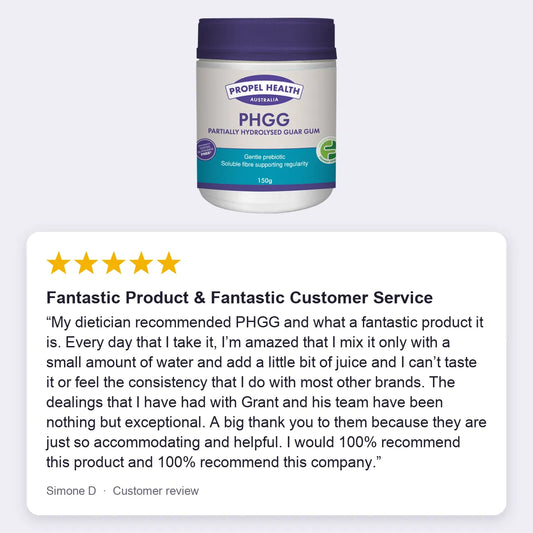
PHGG is partially hydrolysed guar gum, from the guar bean. Raw guar gum is a thickener far too viscous to drink, so it is partially hydrolysed: the long chains are broken into short ones, which removes the thickening and keeps the fibre.
Both dissolve clear. Neither gels. Inulin is faintly sweet; PHGG tastes of almost nothing.
Is PHGG a prebiotic?
Yes. A prebiotic is a substrate selectively used by gut microorganisms, and PHGG is routinely classified as a prebiotic fibre in the research literature.
The real difference between the two is not prebiotic status. It is fermentation rate.
Inulin is fermented quickly, mostly in the first part of the large bowel. PHGG is fermented gradually along its whole length.
Inulin vs PHGG side by side
| Propel Health Organic Inulin | Propel Health PHGG | |
|---|---|---|
| Source | Organic Jerusalem artichoke | Guar bean |
| Fibre type | Fructan, fast fermenting | Galactomannan, slow fermenting |
| Serve size | 5 g | 6 g, four rounded teaspoons |
| Dietary fibre per serve | About 4.5 g | 5.2 g |
| Thickens a drink | No | No |
| Taste | Faintly sweet | None |
| FODMAP status | Fructan, a FODMAP | Certified FODMAP Friendly at a 5 g serve |
| Symptom-free range in published data | Up to about 5 g a day | Up to about 11 g a day |
| Pack sizes | 250 g and 500 g | 150 g and 300 g |
| Cost per gram of fibre | Lower | Higher |
Product figures are from the printed Propel Health labels.
Is PHGG better tolerated than inulin?
This is the most asked version of the question, and the careful answer is more useful than a confident one.
No published trial has compared inulin and PHGG head to head for wind and bloating. What exists is dose-tolerance research on each fibre separately, pulled together in a 2022 review in Advances in Nutrition.
- Inulin: up to 5 g a day is the amount recommended to avoid more than mild flatulence. At 22 g a day and above, people dropped out of studies.
- PHGG: 5 to 11.4 g a day produced no undesirable tolerance effects. Between 13 and 40 g a day, mild to moderate flatulence was generally reported.
So PHGG's comfortable range runs roughly twice as far. That fits the mechanism: a fibre fermented slowly along the bowel produces gas slowly.
One caveat: this is an indirect comparison across different studies, which is weaker evidence than a head-to-head trial. Both label serves, 5 g of inulin and 6 g of PHGG, sit inside the comfortable range anyway.
Does PHGG cause less gas than inulin?
At matched doses the evidence points that way, and the mechanism supports it. Nobody has measured it directly between these two fibres, so read it as a well supported expectation, not a proven result.
Mild wind in the first week of any prebiotic fibre is common and usually settles as the body adjusts.
Which one to choose
Choose Propel Health Organic Inulin if:
- Fibre hasn't given you trouble before.
- You want the most fibre per dollar.
- You want something that disappears into coffee, tea or a smoothie.
Shop Organic Inulin, 250 g and 500 g
Choose Propel Health PHGG if:
- Fibre supplements have given you trouble in the past.
- You want the certified FODMAP Friendly option (at a 5 g serve).
- You want a slow, even fermentation rather than a fast one.
Both can be taken together. They ferment in different places at different speeds. Add one at a time so you know which is which.
Dietary fibre contributes to regular laxation.
How to start either one
- Start at half a serve. About half a teaspoon of inulin, or 2 rounded teaspoons of PHGG.
- Hold there for four or five days.
- Move to a full serve. The PHGG label suggests starting at 5 g (three teaspoons) and building to 6 g (four teaspoons).
- Keep water up.
- Give it two weeks before judging it.
- One new fibre at a time.
Questions people ask
Which has more fibre?
Per serve, PHGG: 5.2 g against about 4.5 g, because the serve is larger. Inulin costs less per gram of fibre.
Can inulin and PHGG be taken together?
Yes. Introduce them one at a time.
Which suits a sensitive stomach?
PHGG, on the tolerance data and the FODMAP Friendly certification. Inulin is a fructan, which is a FODMAP.
Is Propel Health inulin from chicory root?
No. It is organic inulin from Jerusalem artichoke. Its shorter chains ferment faster, so starting low matters more.
What about psyllium husk?
Different fibre, different job: psyllium gels and bulks rather than ferments. See inulin vs psyllium husk and psyllium husk vs partially hydrolysed guar gum.
If PHGG is the one for you, read next: PHGG dosage, timing and what to expect in the first two weeks.
About the author
Grant Jenkins is a co-founder of Propel Health Australia, an Accredited Exercise Physiologist and a high performance coach with almost 30 years working with elite and developing athletes.
References
- Gastrointestinal Effects and Tolerance of Nondigestible Carbohydrate Consumption. Advances in Nutrition, 2022, 13(6):2237-2276.
- Australia New Zealand Food Standards Code, Schedule 4, Nutrition, health and related claims.
- FODMAP Friendly certification programme.
- Propel Health Australia printed label artwork: Organic Inulin and PHGG.
This article is general information, not medical advice. Propel Health Australia products are foods, not therapeutic goods. Speak with your doctor, pharmacist or an Accredited Practising Dietitian about your own situation.