Whey Protein vs Collagen Protein: Why the Amino Acids Decide It
More on: Collagen Guides · Whey Protein Isolate Guides
TL;DR: Whey protein vs collagen protein is decided by amino acids: collagen contains no tryptophan, so it is an incomplete protein with a PDCAAS of 0, while whey is complete and scores 1.00, the maximum. For counting protein towards a daily target, whey does that job; collagen is a specific amino acid profile rich in glycine and proline. They are not substitutes, but taking both is fine.
Whey protein vs collagen protein is usually framed as a choice.
It is closer to a category error.
Both are called protein and both are powders, but they are built from such different amino acids that swapping one for the other changes what is being eaten.
Shop Propel Health Pure Whey Protein Isolate
The one fact that settles it
Collagen contains no tryptophan.
Tryptophan is one of the nine essential amino acids, which the body cannot make and must get from food.
A protein missing one of the nine is, by definition, incomplete.
What the protein quality scores say
PDCAAS, the Protein Digestibility Corrected Amino Acid Score, rates a protein from 0 to 1.00. The score is set by the amino acid in shortest supply relative to requirement.
- Whey protein: 1.00. The maximum.
- Collagen protein: 0. Because tryptophan is missing.
A zero does not mean collagen is worthless or poorly absorbed. It means collagen cannot supply the full set of essential amino acids on its own.
The composition, side by side
| Whey protein | Collagen protein | |
|---|---|---|
| Complete protein | Yes, all nine essential amino acids | No, contains no tryptophan |
| PDCAAS | 1.00 | 0 |
| Essential amino acids as a share | About 43% (milk protein) | About 14% |
| Glycine, proline, hydroxyproline | About 11% | About 47% |
| Leucine | High | Low |
| Source | Milk | Animal connective tissue |
| Dissolves in | Water, milk, shakes | Anything, including hot coffee |
| Allergen | Contains milk | Fish if marine, none declared if bovine |
What each one is for
Whey is a general purpose protein. It is complete and high in leucine. For "more protein in the day" or "protein around training", whey is the straightforward answer.
Collagen is a specific amino acid profile. It is unusually rich in glycine, proline and hydroxyproline. That is why people buy it, and also why it is not a general protein.
Collagen has no pre-approved health claim in Australia, so this article makes none. It sets out what is in it.
Does collagen count towards protein intake?
Partly.
A 2019 paper in Nutrients looked at how much collagen can be included in a diet before the balance of essential amino acids falls short. It found meaningful amounts can be included, provided the rest of the diet supplies the essential amino acids.
The practical reading: collagen is fine as part of protein intake and poor as the whole of it. Replacing a protein powder with collagen quietly cuts essential amino acid intake.
What Propel Health sells, and what is in each
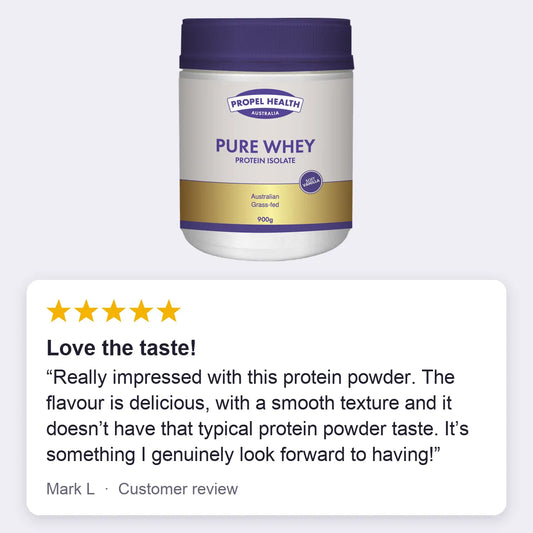
Propel Health Pure Whey Protein Isolate, 900 g. Australian grass-fed whey protein isolate, natural vanilla flavour and organic stevia. 25.1 g of protein per 30 g serve. Contains milk. At that level it is a good source of protein.
Shop Propel Health Pure Whey Protein Isolate, 900 g
Propel Health Hydrolysed Collagen Peptides, 300 g. One ingredient: bovine collagen peptides. 9.0 g of protein per 10 g serve. Unflavoured, and it dissolves into hot coffee.
Shop Propel Health Hydrolysed Collagen Peptides, 300 g
Per gram, the collagen powder is the higher percentage protein. That is a good example of why percentage protein alone is a poor way to compare two powders.
Can you take both?
Yes. They do not interact.
- Whey around training, or whenever protein is short for the day.
- Collagen in the morning coffee, because it dissolves in hot liquid.
- Count the whey towards a protein target. Count collagen only partly.
- Do not replace one with the other. That is the only real mistake available.
For one tub instead of two, there is Propel Health Collagen Protein Powder.
Frequently asked questions
Is collagen a complete protein?
No. It contains no tryptophan, one of the nine essential amino acids.
Is it okay to take collagen and whey together?
Yes. There is no interaction.
Does collagen count towards daily protein?
Partly. It is protein and it is digested, but it does not carry its share of the essential amino acids.
Which has more protein per scoop?
Propel Health Pure Whey Protein Isolate has 25.1 g per 30 g serve. Propel Health Hydrolysed Collagen Peptides has 9.0 g per 10 g serve.
Why does collagen dissolve in coffee when whey does not?
Whey proteins clump in hot liquid. Collagen is already hydrolysed into short peptides and stays in solution.
Is collagen protein the same as gelatin?
Same protein, different processing. Gelatin sets when it cools. Collagen peptides are hydrolysed further and stay dissolved.
Marine or bovine collagen?
That is answered in marine collagen vs bovine collagen.
About the author
Grant Jenkins is co-founder of Propel Health Australia, an ESSA Accredited Exercise Physiologist and a high-performance athletic development coach with almost 30 years of experience.
Propel Health Australia is an Australian, family-owned company based in Brisbane, Queensland, and supplies its range under an Australian food licence.
References
Paul C, Leser S, Oesser S. Significant amounts of functional collagen peptides can be incorporated in the diet while maintaining indispensable amino acid balance. Nutrients, 2019.
Food and Agriculture Organization of the United Nations. Protein Quality Evaluation, PDCAAS methodology.
Food Standards Australia New Zealand. Australia New Zealand Food Standards Code, Standard 1.2.7 and Schedule 4.
Propel Health Australia. Product information, Pure Whey Protein Isolate 900 g and Hydrolysed Collagen Peptides 300 g.
Disclaimer
This article is general information and is not medical advice. Propel Health Australia products are foods, not therapeutic goods, and are not intended to diagnose, treat, cure or prevent any disease. Speak with a doctor, pharmacist or Accredited Practising Dietitian about individual needs. No health claim is made for collagen in this article.