How to Take PHGG - FAQ
TL;DR: PHGG is a soluble prebiotic fibre that can support bowel regularity, stool consistency and gut health. Around 5 g to 7 g daily is commonly used in research, but start with a smaller amount, increase gradually and follow your product's directions.
So this one skips the introduction and answers the practical questions instead.
PHGG dosage: how much PHGG per day?
Most of the published research on PHGG uses somewhere between 5 g and 7 g per day. That is the range where the studies on bowel regularity and stool consistency generally sit, and it is a sensible target for most adults.
The clinical work often lands right in the middle of that. The hospital studies frequently use around 5 g daily, taken with meals, and trials looking at the gut environment commonly use 6 g.
A few things worth knowing about that number:
More is not better. PHGG is fermented by your gut bacteria. Give them a very large amount at once and the result is gas and discomfort, not a faster outcome. The dose that works is the one you can take every day without noticing it.
Check the pack for your specific product. Serving sizes differ between brands and formats. Our Partially Hydrolysed Guar Gum states its serving on the label, and that is the number to follow rather than anything you read in an article, including this one.
Start low, build slow. Begin with a smaller amount of PHGG and gradually increase toward a full serve over one to two weeks. This gives your gut bacteria time to adjust and may help reduce initial gas and bloating.
When to take PHGG: what is the best time of day?
PHGG is not like a medication with a narrow window.
It is a fibre being fermented over hours in your large intestine. Whether it went in at 7am or 7pm makes very little difference to what your gut bacteria do with it.
That said, there are a few practical reasons people pick particular times:
Morning is the most popular, mostly because it attaches to an existing habit. Coffee, water, a smoothie. If you are the sort of person who forgets things after 9am, morning wins by default.
With a meal suits anyone whose digestion is sensitive. Food slows everything down and tends to make the introduction gentler.
Evening works well for people focused on morning regularity, simply because of the timing of the overnight transit.
Before bed is fine. PHGG has no stimulant effect and will not keep you awake.
What matters far more than the hour is that it happens daily. A perfectly timed dose four days a week does less than an imperfectly timed dose seven days a week.
How to take PHGG
Almost anything, which is the main practical advantage it has over other fibres.
Good PHGG dissolves completely and does not thicken. No grit, no gel, no texture. That means:
- Water, plain or sparkling
- Tea and coffee, hot or cold
- Juice
- Smoothies
- Yoghurt
- Soup, sauces, mince, porridge, baked goods
It is genuinely tasteless when it is pure, so it disappears into whatever you put it in. This is why people manage to stay on it when they have failed with grittier or gel-forming fibres before.
Two small notes. Stir rather than dumping it in and walking away, as with any powder. And if you are adding it to something hot, it handles heat fine.
How long does PHGG take to work?
Expect two to four weeks before you have a fair read on it.
PHGG does not act on your bowel directly. It feeds bacteria, those bacteria multiply and ferment, and the composition of your gut population shifts over weeks rather than hours. You are changing an ecosystem, not taking a laxative.
Is PHGG a prebiotic, and is it soluble or insoluble fibre?
Yes to both, and the two facts are related.
PHGG is a soluble fibre. It dissolves in water, which is why it disappears into a glass without thickening. Insoluble fibre, wheat bran being the classic example, does not dissolve and works differently, largely by adding bulk.
It is also a prebiotic, meaning it is not digested in your upper digestive tract and instead reaches the large intestine intact, where your gut bacteria ferment it.
That fermentation produces short-chain fatty acids, butyrate among them, and PHGG is of particular interest because it is highly fermentable and produces butyrate at a higher rate than many other fibres.
Is PHGG low FODMAP?
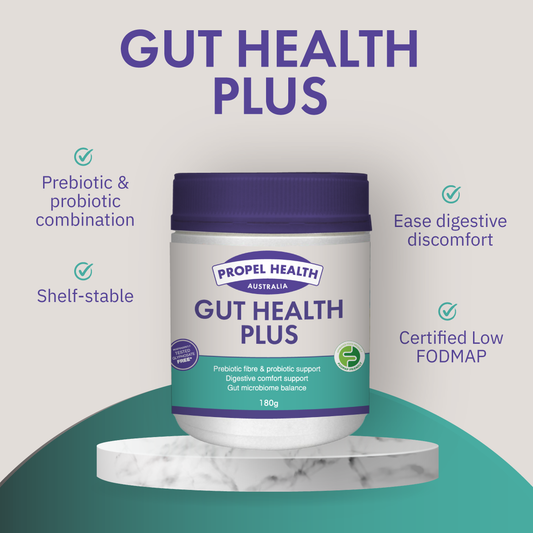
Our Partially Hydrolysed Guar Gum is FODMAP Friendly Certified, which means it has been independently tested and certified rather than simply described that way.
This is one of the main reasons PHGG gets recommended by dietitians working with people on a low FODMAP protocol. A lot of otherwise useful prebiotic fibres, inulin and FOS among them, are high FODMAP and are difficult for that group. PHGG is not.
Do check the certification on whatever you buy rather than assuming it applies to all PHGG products. Certification is per product.
PHGG Benefits: What does PHGG do?
Stripped of marketing, three things are worth stating plainly.
It supports bowel regularity. This is the main reason people take it and it is what most of the research looks at.
It helps maintain stool consistency. Notably in both directions, which is unusual and is why it turns up in clinical nutrition settings.
It increases your daily fibre intake without effort. Most Australian adults fall short of recommended fibre, and PHGG is one of the easier ways to close that gap because it does not require you to change what you eat or tolerate any texture.
What it is not: a laxative, a treatment for any medical condition, or a fast fix.
It is a food, and it is fibre. If you have a diagnosed digestive condition, the right move is to talk to your doctor or dietitian about whether it fits your situation rather than self-managing.
Can you take PHGG every day?
Yes, and daily use is the point rather than a compromise. It is a dietary fibre, which is a normal component of food, and the benefit comes from consistency rather than from cycling on and off.
There is no established need to take breaks. If you stop, you simply go back to your baseline fibre intake.
Where to Buy PHGG?
Propel Health PHGG can be found in over 550 pharmacies and health food stores across Australia.
Or you can buy PHGG right here.
About the Author
Grant Jenkins is the founder of Propel Health Australia and a high-performance coach and physiologist with over 25 years’ experience in human performance, nutrition and health education. He combines scientific research with practical experience to help Australians make informed decisions about nutrition, gut health and supplementation.
Disclaimer
This article is general information and is not medical advice. If you have a diagnosed digestive condition, take medication, or your symptoms persist, speak to your doctor or an accredited practising dietitian.
Comparing fibres? We also cover the benefits of psyllium husk powder and how much to take.