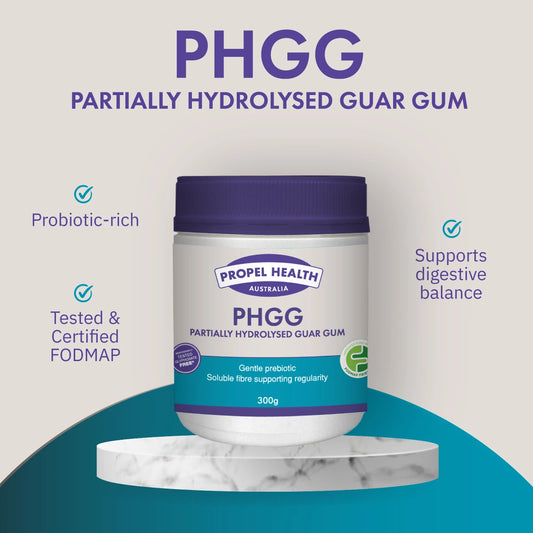
PHGG: The Dietitian-Recommended Prebiotic Fibre Supplement for IBS
Ask a dietitian in Australia which gut health supplement they recommend most consistently for IBS, and PHGG will come up in almost every conversation.
Partially Hydrolysed Guar Gum has built a formidable clinical reputation over two decades of research and real-world application, establishing itself as the prebiotic supplement of choice in situations where gut sensitivity makes other fibres difficult to tolerate.
Despite its growing reputation among health professionals, PHGG remains less well known among the general public than probiotics, psyllium husk, or inulin.
This guide explains exactly what it is, the research behind it, who benefits most, and how to use it effectively as a daily supplement.
What Is Partially Hydrolysed Guar Gum?
Guar gum is a natural polysaccharide derived from the seeds of the guar plant, Cyamopsis tetragonoloba, a legume widely cultivated in India and Pakistan.
In its standard form, guar gum is a highly viscous, gel-forming substance used extensively in the food industry as a thickenerand stabiliser. Standard guar gum is too viscous for comfortable digestive use at therapeutic doses.
Partial hydrolysis resolves this problem. Through a controlled enzymatic process, the long guar gum polysaccharide chains are partially broken down into shorter segments. This reduces viscosity dramatically while retaining the prebiotic properties of the fibre.
The result, PHGG, dissolves completely in water with minimal effect on texture, has virtually no taste, and ferments gently and gradually in the colon rather than producing the rapid, uncomfortable gas associated with standard guar gum.
The resulting supplement is one of the most practically versatile prebiotic fibres available. It can be added to any liquid, food, or beverage without altering taste or texture, which makes daily compliance significantly easier than with flavoured or textured supplements.
Why PHGG Stands Apart from Other Fibre Supplements
Tolerability in Sensitive Digestive Systems
The most significant differentiator of PHGG from other prebiotic supplements is its tolerability profile in people with compromised or sensitive digestive function.
Most fibre supplements, when introduced at therapeutic doses, cause a predictable period of bloating, gas, and abdominal discomfort as the gut microbiome adjusts to the increased fermentable substrate.
PHGG's slow, gradual fermentation rate means this adjustment period is significantly milder than with comparable supplements.
Clinical comparisons between PHGG and psyllium husk have consistently found PHGG produces substantially less gas production and bloating at equivalent doses. This is not merely an academic distinction.
For people with IBS, where bloating and gas are already primary symptoms, a supplement that worsens these symptoms during the adaptation period will simply not be used consistently enough to produce benefits.
FODMAP Friendly Certification
PHGG is certified both FODMAP Friendly and low-FODMAP by Monash University in Melbourne, the institution that developed and validated the low-FODMAP dietary protocol for managing IBS.
This certification is critically important because many fibre and prebiotic supplements contain FODMAPs (fermentable oligosaccharides, disaccharides, monosaccharides, and polyols) that are specifically contraindicated during the elimination phase of a FODMAP protocol.
For the estimated fifteen percent of Australians who live with IBS, many of whom manage their symptoms through dietary modification including low-FODMAP eating, having a gut health supplement that is certified safe within this framework removes a significant barrier to supplementation.
PHGG can be taken during both the elimination and reintroduction phases of the FODMAP protocol without concern.
Bidirectional Regulation of Bowel Habit
One of the most clinically interesting properties of PHGG is its apparent ability to normalise bowel habit in both constipation-predominant and diarrhoea-predominant presentations.
This bidirectional effect, which has been demonstrated in multiple clinical trials, makes PHGG broadly applicable to IBS-C and IBS-D alike, which is unusual among gut health supplements that typically affect motility in one direction.
The proposed mechanism involves PHGG's effect on stool water content and gut transit time, both of which it appears to moderate toward a physiologically normal range rather than pushing in either direction.
This normalisation effect reflects the broader function of prebiotic fibre in creating a balanced, well-functioning gut environment.
The Clinical Evidence for PHGG
IBS Symptom Reduction
Several randomised controlled trials have examined PHGG specifically in IBS populations, and the results are consistently positive.
A notable study published in Digestive and Liver Disease compared PHGG supplementation to a low-FODMAP diet in a group of IBS patients over twelve weeks.
Both interventions produced clinically meaningful improvements in IBS symptom scores, but PHGG supplementation showed better long-term compliance, as many patients found the dietary restrictions of a low-FODMAP protocol difficult to maintain.
A study published in the American Journal of Gastroenterology demonstrated significant reductions in IBS symptom severity scores in participants supplementing with PHGG compared to placebo, with particular improvements in abdominal pain, bloating, and bowel habit consistency.
Gut Microbiome Effects
Multiple studies have examined PHGG's effects on gut microbiome composition and consistently found increases in Bifidobacterium and Lactobacillus populations with regular supplementation.
These bacterial genera are among the most beneficial in the gut microbiome and are typically reduced in people with IBS compared to healthy controls. Restoring these populations through prebiotic supplementation is associated with improved symptom scores, reduced intestinal inflammation, and better gut barrier function.
Research has also demonstrated that PHGG supplementation increases total short-chain fatty acid production in the colon, supporting colonocyte health and intestinal barrier integrity.
Blood Sugar Regulation
An interesting secondary benefit of PHGG supplementation that has emerged from clinical research is its effect on postprandial blood glucose.
PHGG moderately slows gastric emptying and the absorption of glucose from meals, producing a more gradual blood sugar response after eating.
This property has been studied in diabetic and pre-diabetic populations with promising results, and may be a relevant secondary benefit for people with blood sugar management concerns.
PHGG is the only prebiotic fibre supplement with Monash University FODMAP certification. For anyone managing IBS through dietary protocols, this is a non-negotiable consideration.
Bowel Clinic and Dietitian Recommendations
Propel Health's PHGG Powder has a particularly strong track record of professional recommendation by gastroenterologists, dietitians, and bowel clinic practitioners in Australia.
Customer reviews consistently cite professional referrals as the reason for starting the supplement, and clinical outcomes reported in these reviews (significant IBS symptom improvement, improved bowel regularity, reduced bloating) align with the results seen in clinical trials.
This pattern of professional recommendation reflects the confidence the clinical community has developed in PHGG over two decades of use and research.
Few over-the-counter gut health supplements have achieved this level of professional endorsement.
How to Use PHGG as a Daily Gut Health Supplement
Starting Dose
Begin with one gram for two to three days. Slowly, approximately every two to three days increase your daily does. until you reach five grams.
This allows the gut microbiome to begin adjusting to increased prebiotic fibre availability without overwhelm.
Most people experience minimal side effects at this starting dose.
Building to Maintenance Dose
After two to four weeks at the starting dose, most people can increase to ten grams (two teaspoons) daily without significant side effects.
Some individuals benefit from doses up to fifteen grams, particularly for managing constipation-predominant IBS. Build the dose gradually based on your individual tolerance.
How to Take It
Mix PHGG powder into a glass of water, juice, milk, smoothie, yoghurt, oats, or any food or beverage of your choice. It dissolves completely with brief stirring and does not alter the texture or taste of whatever it is added to.
This makes it uniquely easy to incorporate into a daily routine compared to other fibre supplements that have noticeable flavour, texture, or gelling effects.
When to Expect Results
Improvements in bowel regularity are often noticed within one to two weeks of consistent daily supplementation.
Broader improvements in gut comfort, bloating, and IBS symptom severity typically become noticeable within four to six weeks.
The microbiome-level changes thatunderpin these improvements, including increased Bifidobacterium populations, take six to eight weeks of consistent daily use to establish meaningfully.
For maximum benefit, PHGG should be taken daily rather than sporadically.
Consistency of prebiotic supply is what creates the stable microbiome environment that produces long-term gut health improvements.
For a comprehensive overview of gut health supplement options beyond PHGG, see our guide to the best gut health supplements in Australia.
To understand where PHGG fits relative to probiotic supplements, see our guide to prebiotics vs probiotics.
About the Author
Grant Jenkins is the founder of Propel Health Australia and a high-performance coach & physiologist with over 25 years’ experience working with elite and developing athletes. He has formulated nutritional supplements used by athletes, families and health professionals across Australia. Grant combines real-world coaching experience with evidence-based research to bridge the gap between performance science and practical health.
Disclaimer
Propel Health offers this article for education purposes only. Please consult your Health Practitioner for personalised and specific information.