Psyllium Husk vs. Partially Hydrolysed Guar Gum (PHGG)
More on: FODMAP Friendly Guides · Gut Health Guides · PHGG Guides · Psyllium Husk Guides
TL;DR: Psyllium husk and PHGG are both effective soluble fibre supplements, but they suit different needs. Psyllium is best known for adding bulk and supporting constipation relief, while PHGG is a gentler, low-FODMAP prebiotic fibre that dissolves completely and is better suited to sensitive digestion, IBS support and long-term gut microbiome health.
When it comes to supporting digestive health, gut health supplements have become a daily staple for many Australians.
Two of the most popular options are psyllium husk and PHGG fibre (partially hydrolysed guar gum).
Both are soluble fibres with proven benefits but they work in very different ways.
The key question isn’t which one is “better”…
It’s which one is better for your goal, your gut, and your lifestyle.
What Are Psyllium Husk and PHGG?
Psyllium Husk
Psyllium husk is a soluble fibre derived from the seeds of the Plantago ovata plant.
It absorbs water and forms a gel-like substance in the digestive tract, helping to:
- Increase stool bulk
- Promote bowel regularity
- Support cholesterol and blood sugar control
It’s one of the most widely used fibres globally, particularly for constipation.
Partially Hydrolysed Guar Gum (PHGG)
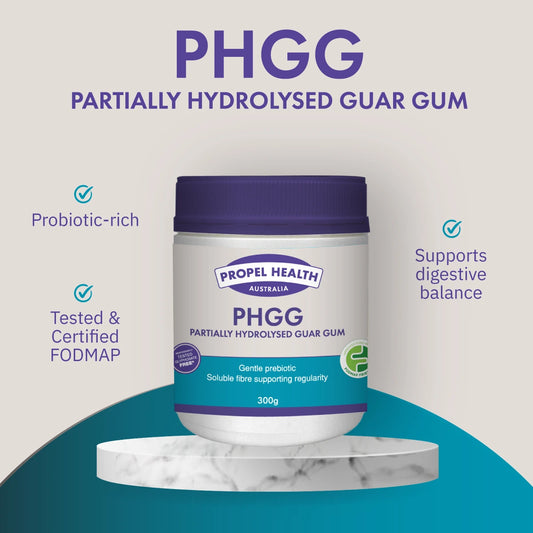
PHGG is derived from guar beans but processed into a low-viscosity, highly tolerable fibre.
Unlike psyllium, PHGG:
- Fully dissolves in water
- Does not thicken
- Acts as a prebiotic, feeding beneficial gut bacteria
It’s also FODMAP-friendly certified, making it suitable for people with IBS or sensitive digestion.
Digestive Tolerance
Psyllium Husk
Psyllium works by expanding in the gut, which can be effective but for some people, this can lead to:
- Bloating
- Gas
- Cramping (especially when starting)
This effect is more noticeable in people with sensitive digestion.
PHGG
PHGG is known for being gentle and well tolerated.
Because it doesn’t swell or form a thick gel:
- It causes minimal bloating
- It supports gradual fermentation in the gut
- It’s su/itable for long-term daily use
Best choice
- Sensitive gut / IBS → PHGG
- No gut sensitivity → Either can work
Prebiotic & Gut Microbiome Benefits
Psyllium Husk
Psyllium supports digestion primarily through mechanical effects (bulk and movement).
It does have some interaction with gut bacteria, but it’s not considered a strong prebiotic.
PHGG
PHGG is a clinically studied prebiotic fibre.
It selectively feeds beneficial bacteria such as:
- Bifidobacteria
- Lactobacilli
This can support:
- Gut microbiome balance
- Digestive comfort
- Immune health
- Even gut–brain axis function
Best choice?
- Microbiome, gut health, long-term optimisation → PHGG
Bowel Regularity & Constipation
Psyllium Husk
Psyllium is highly effective for constipation relief.
It works by:
- Absorbing water
- Increasing stool size
- Stimulating bowel movements
This makes it ideal for people needing bulk-forming fibre.
PHGG
PHGG supports regularity in a different way:
- Improves gut motility
- Supports stool consistency
- Helps regulate both constipation and diarrhoea by restoring balance
This makes it particularly useful for people with irregular or unpredictable digestion.
Best choice?
FODMAP & IBS Suitability
Psyllium Husk
Psyllium is often tolerated but it’s not formally FODMAP-certified.
Some individuals with IBS may still experience discomfort.
PHGG
PHGG is certified low FODMAP, making it a reliable option for:
- IBS
- Bloating
- Sensitive digestion
Best choice?
- IBS / low-FODMAP diet → PHGG
Ease of Use & Daily Compliance
Psyllium Husk
- Thickens quickly
- Can become gel-like
- Requires quick consumption
Some people find the texture difficult to maintain long-term.
PHGG
- Completely dissolves
- Tasteless
- No texture
It can be added to:
- Water
- Coffee
- Smoothies
- Meals
Best choice?
- Daily convenience → PHGG
For a side by side of grams of fibre per serve and cost per serve across psyllium, PHGG, inulin and fibre blends, see this fibre supplement for gut health comparison.
Metabolic & Additional Health Benefits
Psyllium Husk
Well-supported for:
- Bulking and stool form
- Bowel regularity
- Daily fibre intake
PHGG
Also supports:
- Feeding beneficial gut bacteria
- Short-chain fatty acid production
- Gut-derived inflammation
Plus additional benefits via the microbiome, including:
- Immune support
- Gut-brain axis effects
Best choice?
So… Which One Should You Choose?
Choose Psyllium Husk if you:
- Primarily want constipation relief
- Prefer a traditional, bulk-forming fibre
- Are not sensitive to bloating
Choose PHGG if you:
- Have IBS or a sensitive gut
- Want to improve your gut microbiome
- Experience both constipation and diarrhoea
- Want a gentle, daily fibre you can stick to
- Prefer something tasteless and easy to mix
A Practical Way to Think About It
- Psyllium = Mechanical fibre (bulk, movement, structure)
- PHGG = Functional fibre (microbiome, balance, tolerance)
Both have a role... it just depends on what your body needs.
Fibre is also only half of the picture for most people. Protein and fibre do different jobs, which is why they are often taken together, and our protein and fibre supplements in Australia cover both rather than one or the other.
Where to Start
If your goal is simple constipation relief → psyllium may be a good starting point.
If your goal is gut health, IBS support, or long-term digestive optimisation → PHGG is often the better fit.


Choose Independently Tested Supplements
Plant-based supplements are only as good as the ingredients they contain.
Because glyphosate is widely used in modern agriculture, trace residues have been detected in a variety of crops and foods.
For many people, independent testing provides an extra level of confidence that a supplement is as clean as possible.
When choosing plant-based supplements, look for brands that are transparent about contaminant testing, not just active ingredients, so your supplement supports your health without unnecessary exposure to unwanted residues.
Final Takeaway
Both psyllium husk and PHGG are effective fibre supplements but they serve different purposes.
- Psyllium is ideal for short-term, bulk-based regularity
- PHGG is ideal for long-term gut health and digestive balance
Choosing the right fibre isn’t about picking the “best” one it’s about choosing the one that works best for you.
What Is PHGG Fibre, and Is PHGG the Same as Guar Gum?
PHGG fibre is not quite the same as guar gum: it is partially hydrolysed guar gum, guar gum that has been broken down into shorter chains so it dissolves clear and stays liquid instead of thickening. That single difference is why it behaves so differently to psyllium in everyday use.
We set out how much fibre is in a serve, against the Australian daily targets, in PHGG fibre per serve.
It is a soluble prebiotic fibre, it is low FODMAP certified, and it has virtually no taste, so it stirs into water, coffee or food without changing them. People generally choose PHGG fibre when psyllium has been too harsh, and psyllium when bulk is the point. See our PHGG fibre.
Is PHGG Soluble or Insoluble Fibre?
PHGG is a soluble fibre: it dissolves completely in water and stays thin, where insoluble fibres such as wheat bran do not dissolve at all. Psyllium is mostly soluble too, but it swells into a thick gel, which is the practical difference you notice in the glass.
Conclusion
Both psyllium husk and partially hydrolysed guar gum are excellent fibre supplements, but they cater to different needs.
Psyllium husk excels in adding bulk and promoting regularity for individuals dealing primarily with constipation.
However, PHGG’s low FODMAP status, prebiotic benefits, and gentle action on the gut make it a superior choice for those with sensitive digestive systems or broader health goals.
For anyone looking to support their gut health without the risk of bloating or discomfort—and especially for individuals with IBS—PHGG is the better option.
Its versatility, ease of use, and scientifically-backed benefits make it a modern, gut-friendly fibre supplement that goes beyond digestion to support overall well-being.
Investing in PHGG can help you achieve a healthier, happier gut, and a better quality of life.
About the Author
Grant Jenkins is the founder of Propel Health Australia and a high-performance coach with over 25 years’ experience working with elite and developing athletes. He has formulated nutritional supplements used by athletes, families and health professionals across Australia. Grant combines real-world coaching experience with evidence-based research to bridge the gap between performance science and practical health.
Disclaimer:
We offer this post for education purposes only. Please consult your Health Practitioner for personalised and specific information.
Decided on PHGG? Our guide covers how much PHGG to take per day and the best time to take it.
Want the detail on psyllium on its own? See the benefits of psyllium husk powder, dosage and how it compares to other fibres.