Research: Reduce Wrinkles Naturally
TL;DR: If you're trying to reduce wrinkles naturally, emerging research suggests adding PHGG to your diet can help. A randomised, double-blind clinical trial found that taking 5 g of PHGG daily improved skin hydration, reduced water loss and improved measures of skin elasticity within 12 weeks.
When you think about how to reduce wrinkles naturally, you most likely think about what you put on your skin.
Moisturisers. Serums. Sunscreen. Oils.
But researchers are increasingly interested in your gut.
The connection between the gut and skin is sometimes referred to as the gut-skin axis, and a recent human clinical trial suggests that feeding your gut bacteria with a PHGG may influence some of the characteristics we associate with younger-looking skin.
Here's what the researchers discovered.
Why Do Wrinkles Develop?
Wrinkles are a normal part of ageing.
But their appearance is influenced by several characteristics of the skin, including its hydration, elasticity and ability to retain water.
The researchers behind the PHGG study noted that skin hydration can influence characteristics including:
- dryness,
- roughness,
- flexibility,
- wrinkles,
- laxity and
- viscoelasticity.
As skin becomes drier and loses some of its elastic properties, fine lines become more noticeable.
That's why looking after ageing skin isn't necessarily just about targeting the wrinkle itself.
Supporting the hydration, barrier function and elasticity of the skin matter.
And that's where this study becomes particularly interesting.
Can Gut Health Help Reduce Wrinkles Naturally?
Researchers investigated whether a prebiotic fibre called Partially Hydrolysed Guar Gum (PHGG) could influence skin health.
PHGG is a soluble dietary fibre that passes through the upper digestive tract largely undigested before being fermented by bacteria in the colon.
The clinical trial included 70 healthy adults aged 30 to 60, with an average age of just over 45 years.
Participants were randomly assigned to receive either:
5 g PHGG per day
or
5 g placebo per day
for 12 weeks.
Neither the participants nor researchers knew who was receiving PHGG until the study was completed.
Researchers then measured skin hydration, trans-epidermal water loss and several measures of skin elasticity and viscoelasticity.
They also assessed participants' perceptions of wrinkles, firmness, smoothness, sagging, dryness and other characteristics of their skin.
What Happened After Taking PHGG?
The results were intriguing.
After six weeks of PHGG supplementation, skin moisture increased from baseline at several measured locations.
On the cheek, skin hydration increased by approximately 7.1%.
More importantly, the researchers measured something called trans-epidermal water loss (TEWL).
This measures how much water escapes through the skin and is commonly used as an indicator of skin barrier function.
After six weeks, TEWL in the PHGG group decreased by approximately:
- 11.8% at the cheek
- 13.2% at the upper arm
- 17.2% at the upper back
The researchers also reported improvements in several measures of skin elasticity and viscoelasticity, with significant differences between PHGG and placebo for several elasticity measures after 12 weeks.
Simply:
The skin became better hydrated, lost less water and showed improvements in how it stretched and recovered.
These are all characteristics relevant to how healthy and ageing skin looks and feels.
What About Wrinkles Specifically?
Wrinkles and fine creases were included among the subjective skin characteristics assessed by participants.
PHGG supplementation was associated with improvements in:
Skin hydration → water retention → skin elasticity → skin texture
And those characteristics are particularly relevant when considering natural approaches to ageing skin.
The Gut-Skin Connection
So how could something you eat affect the skin on your face?
The answer may involve your gut microbiome.
PHGG is a prebiotic.
Rather than simply being absorbed in the small intestine, PHGG reaches the colon where it can be fermented by gut bacteria.
This fermentation produces compounds called short-chain fatty acids (SCFAs).
The researchers discuss several possible pathways through which these compounds could influence the skin, including skin barrier function and inflammatory processes.
They specifically hypothesised that SCFAs produced through bacterial fermentation of PHGG could contribute to improvements in dry or disrupted skin.
This creates an interesting shift in the way we think about skin ageing.
We normally think:
Skin problem → put something on the skin.
The gut-skin axis raises another possibility:
Diet → gut microbiome → skin health.
People Over 45 - Interesting Results
Researchers divided participants into those aged 45 and younger and those aged 46 and older.
This is important because the authors specifically discuss the skin changes associated with ageing and perimenopause, including declining collagen and elastin formation and repair.
Among participants aged 46 and over who received PHGG, researchers reported:
significant improvements from baseline in skin hydration and elasticity measures.
TEWL also decreased significantly in this older PHGG group.
It makes the findings particularly interesting for people searching for ways to support their skin as they get older.
How Much PHGG for Improved Skin?
Participants consumed:
5 g of PHGG once per day for 12 weeks.
That provided approximately 4 g of soluble dietary fibre.
Participants could take it before or after meals.
Importantly, the researchers reported no adverse events during the study, and compliance was greater than 98.5%.
How to Reduce Wrinkles Naturally: Think Beyond Skincare
There probably isn't one food, supplement or skincare product that will stop skin ageing.
But this research suggests that people looking to reduce wrinkles naturally may want to think beyond what they're putting on their face.
Skin hydration and elasticity are important components of healthy-looking skin.
Increasingly, research is suggesting that nutrition (and the gut microbiome) may play a role in supporting them.
In this randomised, double-blind, placebo-controlled trial, 5 g of PHGG per day was associated with improved skin hydration, reduced water loss and improvements in several measures of skin elasticity over 12 weeks.
It doesn't mean that prebiotic fibre is a wrinkle cure.
It does suggest something more interesting:
Healthy-looking skin may start much deeper than the surface.
What About Hyaluronic Acid?
PHGG isn't the only supplement being studied for supporting skin from the inside.
Research has also investigated whether consuming hyaluronic acid may help improve skin hydration, elasticity and the appearance of wrinkles.
Support Your Skin From the Inside
If you're looking to reduce wrinkles naturally, don't just think about what you put on your skin.
Think about how you support it from within.
The study above used 5 g of PHGG daily for 12 weeks, with improvements in skin hydration, water retention and elasticity.
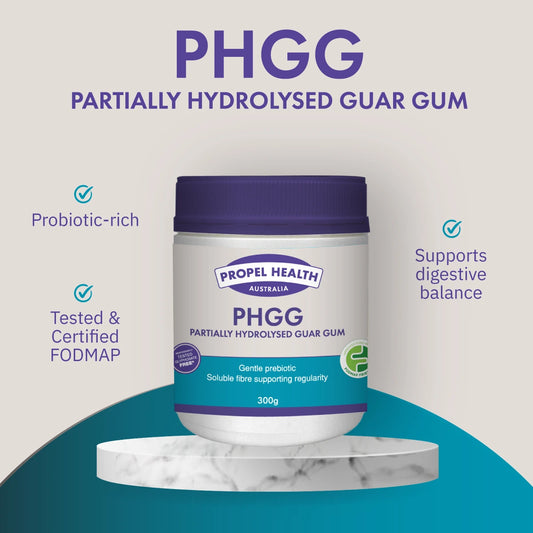
Try PHGG Powder to Reduce Wrinkles Naturally

Reference
Kapoor, M. P., et al. (2025). Dietary intervention of prebiotic partially hydrolyzed guar gum improves skin viscoelasticity, stratum corneum hydration, and reduction of trans-epidermal water loss: a randomized, double-blind, and placebo-controlled clinical study in healthy humans. Journal of Clinical Biochemistry and Nutrition, 76(1), 96–115. https://doi.org/10.3164/jcbn.24-69
About the Author
Grant Jenkins is the founder of Propel Health Australia and a physiologist with more than 25 years of experience in human performance, nutrition and health education. He combines scientific research with practical experience to help Australians make informed decisions about nutrition, supplementation and long-term health.
Disclaimer
This article is provided for educational purposes only and is not intended to diagnose, treat, cure or prevent any disease. Supplements should not replace a balanced diet, appropriate sun protection or professional healthcare advice. Always consult your healthcare practitioner before starting a new supplement, particularly if you have an existing medical condition, are pregnant or breastfeeding, or take medication.