Benefits of Collagen and Vitamin C
The Benefits of Collagen and Vitamin C
TL;DR: Vitamin C is required for normal collagen formation, while collagen supplements provide amino acids used in collagen-rich tissues.
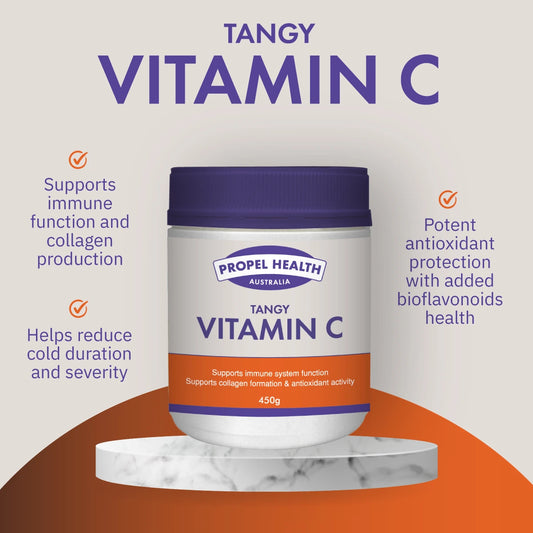
You've probably noticed that Complete Joint Care has Collagen and Vitamin C listed in the ingredeints or that our Joint Health range incudes Collagen Protein Powder and Tangy Vitamin C.
There's a good biological reason for this.
Collagen provides amino acids such as glycine and proline, while vitamin C is required for normal collagen formation.
But there's interesting research suggesting that combining collagen-derived protein, vitamin C and exercise may be particularly relevant for connective tissue.
So, should you take collagen and vitamin C together?
Let's look at the science.
What Does Collagen Do in the Body?
Collagen is the major structural protein in the human body.
It forms an important part of:
- skin
- tendons
- ligaments
- cartilage
- bone
These tissues are constantly being remodelled.
Exercise provides one stimulus for this process. Nutrition provides the body with nutrients required to build and maintain these tissues.
That's where collagen and vitamin C become interesting.
Why Take Collagen and Vitamin C Together?
Collagen and vitamin C perform different but complementary roles.
Collagen Provides Important Amino Acids
Collagen-derived proteins are particularly rich in amino acids such as:
Glycine, proline and hydroxyproline.
When collagen or gelatin is digested, these amino acids and peptides become available in the bloodstream.
In the Shaw study, consuming gelatin resulted in dose-dependent increases in circulating glycine, proline, hydroxyproline and hydroxylysine, with the largest response generally occurring after the 15 g dose.
Vitamin C Supports Normal Collagen Formation
Vitamin C plays a fundamentally different role.
Rather than supplying collagen protein, vitamin C is required for normal collagen formation.
An easy way to think about it is:
Collagen provides building materials. Vitamin C helps support the process used to build collagen.
Collagen and Vitamin C Before Exercise: An Interesting Study
This is where the research gets interesting.
Shaw and colleagues recruited eight healthy, recreationally active men for a randomised, double-blind crossover study.
The participants consumed, either:
- Placebo
- Low collagen drink
- high collagen drink
Participants consumed the supplement one hour before exercise, then completed six minutes of skipping to provide a mechanical stimulus to the musculoskeletal system.
The researchers then measured markers associated with collagen synthesis.
High Collagen + Vitamin C Approximately Doubled Collagen Synthesis Marker
Exercise alone worked.
The placebo condition increased PINP, a blood marker associated with type I collagen synthesis, by approximately 54%.
The low collagen drink produced a similar increase of around 59%.
But with the high collagen plus vitamin C drink, PINP increased by approximately 153% four hours after exercise.
The overall PINP response was approximately doubled compared with placebo.
To investigate connective tissue more directly, they also performed laboratory experiments using engineered ligaments.
Serum collected after participants consumed gelatin increased collagen content in these engineered ligaments, with a greater response as the gelatin dose increased.
Together, the findings suggest that combining collagen-derived protein, vitamin C and mechanical loading may create a favourable nutritional environment for collagen synthesis.
Should You Take Collagen and Vitamin C at the Same Time?
Yes, they can be taken together.
In fact, the Shaw study deliberately combined them.
There is no evidence from this study suggesting vitamin C interferes with the absorption of collagen.
Rather, the combination was chosen because vitamin C has an established role in collagen formation.
For most people, this makes combining the two a practical option rather than taking them separately.
When Should You Take Collagen and Vitamin C?
This is where the study provides an interesting practical clue.
Participants consumed their gelatin and vitamin C one hour before exercise.
The researchers found that collagen-associated amino acids peaked in the bloodstream around this time following the 15 g gelatin dose.
They proposed that consuming collagen-derived protein before loading connective tissue could provide relevant amino acids at the time exercise stimulates collagen synthesis.
If you're using collagen specifically to support tendons, ligaments, bones or joints around exercise, approximately one hour before training is a reasonable research-based strategy.
How Much Collagen and Vitamin C Should You Take?
The study provides some useful context.
The combination of an adequate collagen protein powder (approx 15g) dose, vitamin C and mechanical loading deserves your attention.
Collagen and Vitamin C for Skin
The same basic biology also explains why we formulated Collagen Beauty Boost with vitamin C.
Collagen is a major structural component of skin, while vitamin C contributes to normal collagen formation for normal skin function.
The goal is to ensure the body has adequate vitamin C available to support its normal physiological role.
Collagen and Vitamin C for Joints, Tendons and Ligaments
For active people, or have a history of being active, this is perhaps the most interesting application.
Tendons and ligaments rely heavily on a collagen-rich extracellular matrix, while cartilage and bone also contain significant collagen structures.
Exercise provides the mechanical stimulus these tissues need.
Collagen provides characteristic amino acids.
Vitamin C supports normal collagen formation.
This gives you a useful framework:
Loading + Collagen + Vitamin C
Not collagen instead of rehabilitation.
Not supplements instead of exercise.
Nutrition working alongside appropriate mechanical loading.
Do You Need Vitamin C With Collagen?
What matters physiologically is having adequate vitamin C available because the body requires it for normal collagen formation.
Including vitamin C in a collagen supplement is a convenient way to ensure both nutrients are consumed together.
Collagen and Vitamin C: The Take-Home Message
There's a solid biological reason collagen and vitamin C are frequently combined.
Collagen-derived proteins provide amino acids associated with collagen-rich tissues, while vitamin C is required for normal collagen formation.
The Shaw study adds another interesting layer: 15 g of vitamin C-enriched collagen consumed one hour before exercise produced a substantially greater collagen synthesis marker response than exercise alone.
Support Your Collagen
If you’re looking to combine collagen and vitamin C, explore our range of joint health supplements, including collagen, vitamin C and Complete Joint Care.

About the Author
Grant Jenkins is the founder of Propel Health Australia and a physiologist with more than 25 years of experience in human performance, sports nutrition and health education. He has worked with athletes competing at World Championships and all four tennis Grand Slams, combining scientific research with practical experience in nutrition, supplementation and performance.
Disclaimer
This article is for educational purposes only and is not intended to diagnose, treat, cure or prevent any disease or injury. Collagen and vitamin C supplements should not replace appropriate medical care, rehabilitation or a balanced diet. Speak with a qualified healthcare practitioner if you have an injury or medical condition.
Reference
Shaw G, Lee-Barthel A, Ross MLR, Wang B, Baar K. Vitamin C-enriched gelatin supplementation before intermittent activity augments collagen synthesis. Am J Clin Nutr. 2017;105(1):136-143. doi:10.3945/ajcn.116.138594.