How to Support Your Immune System Naturally
TL;DR: If you want to improve your immune system naturally, focus on removing the things that can hold normal immune function back. Prioritise sleep, adequate protein, fibre and gut health, regular physical activity, and sufficient nutrients such as vitamin C.
Search "how to improve immune system naturally" and you get the same list every time. Sleep more. Stress less. Eat vegetables.
All true, all useful, and all slightly unsatisfying, because none of it tells you what is actually happening or where to start.
So here are the questions people actually ask, answered properly.
How much of your immune system is in your gut?
Most estimates put it at around 70 to 80 per cent. The gut-associated lymphoid tissue, or GALT, is the single largest concentration of immune tissue in the body.
That number surprises people, and it reframes the whole question.
If you are thinking about immune health and you are not thinking about your digestive system, you are ignoring the part of the body where most of the action happens.
There is a practical reason this matters. The bacteria living in your gut are shaped by what you eat, day to day, and those bacteria interact constantly with the immune cells sitting alongside them.
Diet is not a vague background factor here. It is the main input.
This is why we start with the gut on almost everything.
Does fibre affect immunity?
Your gut bacteria feed on fibre that you cannot digest yourself.
Prebiotic fibres in particular pass through to the large intestine intact and become food for beneficial bacteria.
A population of bacteria that is well fed and diverse is the environment your gut immune tissue develops alongside.
The catch is that most people do not eat enough fibre, and the gap is not small. Australian intakes sit well below recommended levels for most adults.
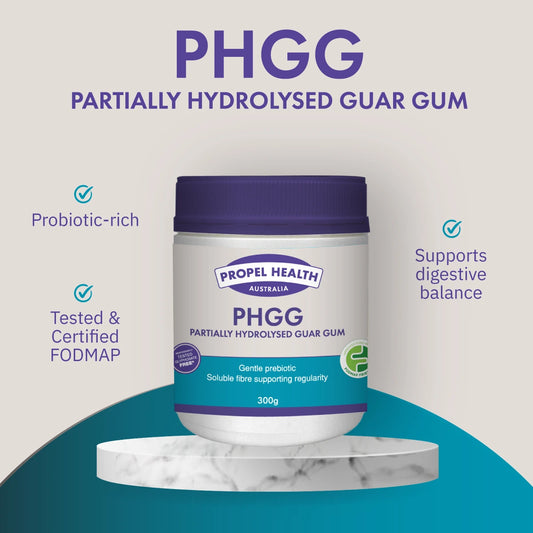
Prebiotic fibres are one of the easier gaps to close because they need no cooking and no change to what you already eat. PHGG, or partially hydrolysed guar gum, is a common choice because it dissolves clear and tasteless into anything, which removes the usual excuse.
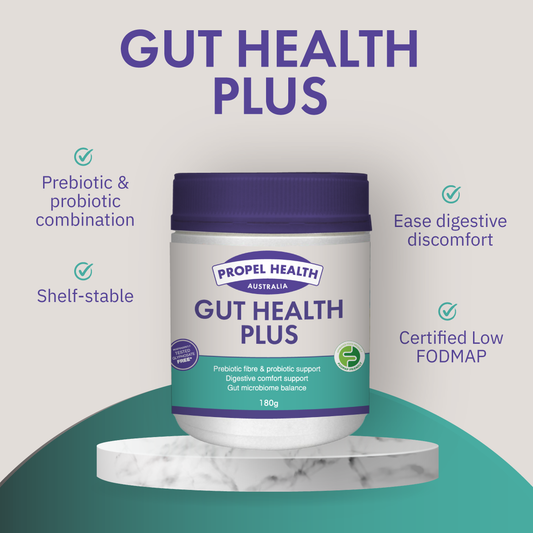
Gut Health Plus pairs that prebiotic fibre with a probiotic (called Bacillus Coagulans), so you are adding beneficial bacteria and feeding them in the same step.
Fibre first, though.
Adding bacteria to a gut with nothing to feed them is doing half the job.
Can you support your immune system?
The honest answer starts with what the immune system is not.
It is not a muscle, and it does not have a strength setting.
You cannot make it perform above normal on demand, and you would not want to.
An immune system running harder than it should is not a healthier one, it is what allergies and autoimmune conditions look like.
So "supercharge your immunity" is marketing. It describes something that is not a real state.
What is real, and well supported, is the other direction.
An immune system can be held back by things you control. Not enough sleep.
Not enough protein. Not enough fibre. A genuine shortfall in a nutrient like vitamin C or zinc. Chronic stress.
These are documented, and they are all correctable.
That is the useful framing, and it is what the rest of this article is about. You are not adding horsepower. You are removing handbrakes.
It is less exciting as a headline and considerably more likely to work.
How much vitamin C should you take a day?
The amount needed to avoid deficiency is modest. Australian guidance sits around 45 mg a day for adults, and internationally the figures used are commonly 75 mg for women and 90 mg for men, with smokers needing more.
That is the floor, not the target. It is the amount that keeps you out of trouble, which is a different question from the amount associated with good status.
A lot of the research interest sits considerably higher, and intakes in the hundreds of milligrams are common in the literature. The upper level considered safe for adults is 2,000 mg a day.
Worth knowing: vitamin C is water soluble, so your body does not store it. Whatever you do not use is excreted. That means consistency matters more than size. A moderate amount daily does more for your status than a large amount occasionally.
Food first is genuinely good advice here. Capsicum, kiwi fruit, citrus, broccoli and berries all carry meaningful amounts. Supplementing is for closing a gap, not replacing the produce aisle.
What is buffered vitamin C?
This is the question people ask after their first bad experience with plain ascorbic acid.
Ascorbic acid is acidic, with a pH around 2 to 3 in solution. For a lot of people that is completely fine. For others, particularly at higher doses or on an empty stomach, it causes discomfort.
Buffered vitamin C combines ascorbic acid with alkaline minerals such as calcium and magnesium, which lifts the pH toward neutral.
The vitamin C is the same vitamin C. What changes is how it sits in your stomach.
Is it better?
Not inherently. It is better for you if plain ascorbic acid bothers you, and irrelevant if it does not.
The genuine advantage is adherence: the supplement that does not upset you is the one you keep taking, and with a nutrient your body does not store, taking it consistently is the entire point.
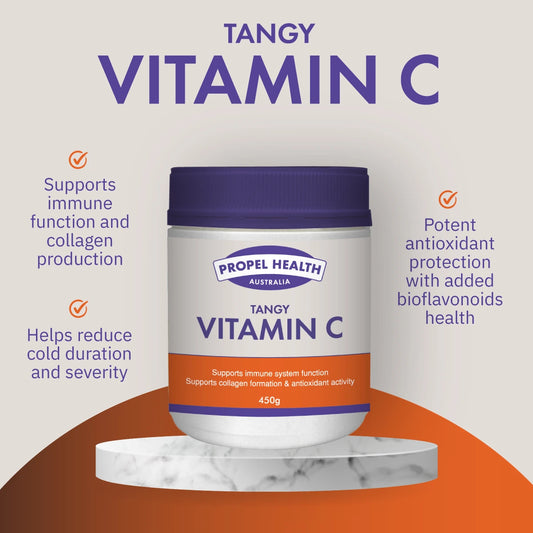
Tangy Vitamin C is buffered for exactly this reason, using calcium ascorbate alongside ascorbic acid. It supports immune system function, and supports collagen formation and antioxidant activity. AUST L 463667.
What does hesperidin do?
This is the question almost nobody asks, and it is the most interesting one.
Hesperidin is a bioflavonoid found naturally in citrus, concentrated in the peel and the white pith rather than the juice.
When you eat an orange you get vitamin C and hesperidin together. When you take isolated ascorbic acid you get the vitamin on its own.
Bioflavonoids are studied for their own antioxidant activity, and for how they behave alongside vitamin C.
The interest is in the pairing rather than either one alone, which is closer to how these compounds turn up in food.
The practical point for anyone comparing products: check whether a vitamin C formula includes bioflavonoids, and if so how much.
Many list them without a meaningful quantity. Tangy Vitamin C contains 190 mg of hesperidin per 2 g serve alongside 964 mg of total vitamin C, so the bioflavonoid is a real inclusion rather than a label decoration.
Vitamins can only be of assistance if dietary vitamin intake is inadequate. If symptoms persist, seek the advice of a healthcare professional.
Does protein affect immune system?
Yes, and this is the gap most people miss entirely while they are busy thinking about vitamins.
Antibodies are proteins. So are the signalling molecules immune cells use to communicate, and the cells themselves are built and replaced from amino acids.
If protein intake is inadequate over time, the raw materials for all of that are in short supply. This is well established in the nutrition literature, and it is one of the clearest diet and immunity links there is.
Specific amino acids attract particular research attention, glutamine among them, because of the role they play in the intestine and in the immune cells resident there. L-Glutamine is available on its own for that reason.
For most people though the answer is simpler: eat more protein, more consistently.
Intake tends to drift down with age, and it tends to be concentrated at dinner when spreading it across the day works better.
A grass-fed whey protein isolate is the low-effort way to add a solid serve at breakfast, which is the meal where most people fall short.
Morning drink to support immune system
If you want one habit instead of a list, make it this one. It works because it attaches to something you already do rather than asking you to remember something new.
The base is a glass of water, cool or room temperature. Then you are adding whichever of these closes your actual gap:
Vitamin C. Tangy Vitamin C is a buffered powder, so it dissolves into water without the acidity that makes plain ascorbic acid uncomfortable first thing. It supports immune system function, and supports collagen formation and antioxidant activity. AUST L 463667. Because vitamin C is not stored, a moderate amount every morning does more for your status than a large amount now and then.
Prebiotic fibre. PHGG dissolves clear and tastes of nothing, which is the entire reason people manage to stick with it. This is a food, not a medicine. It is there to feed your gut bacteria, which is a fibre job rather than an immune claim.
Protein, if breakfast is where you fall short. Whey protein isolate is better in a shaker than stirred into a glass, so treat this as the second half of the routine rather than another spoon in the same water.
Four practical notes that make the difference between doing this and giving up on it:
Never use hot water. Vitamin C degrades with heat and whey clumps badly in it. Cool or room temperature only. This is the most common mistake.
Introduce fibre slowly. Start at half a serve and build over a week or two. Going straight to a full serve is the reason most people quit prebiotic fibre in the first three days.
Same time every day beats the perfect time. Morning is popular because it is repeatable, not because there is anything magic about it.
If you take medication, space the fibre away from it. Fibre can affect how some medicines are absorbed. An hour either side is the usual guidance, and your pharmacist will give you a straight answer for your specific script.
None of this is exciting, which is rather the point. The routine that survives contact with a busy Tuesday is the one that does anything.
How to boost your immune system when sick
This is one of the most searched questions on the topic, and the honest answer is not the one people are hoping for.
By the time you are unwell, the window for nutrition to do much has largely closed.
Diet works on the state your body is in when something arrives, not on the situation once it has. That is not a reason to eat badly while you are sick, it is a reason to stop treating nutrition as an emergency lever.
What genuinely helps once you are already down:
Sleep, more than you think you need. This is where the real recovery happens and it is the one thing nothing substitutes for.
Fluids. Being unwell increases losses and dehydration makes everything feel worse.
Eat something, even if appetite is gone. Protein especially. Your body is manufacturing a great deal of new material and it needs the raw materials to do it.
Rest properly. Training through it or pushing on at work extends the whole thing.
Do not megadose anything in a panic. Very large one-off doses of a water soluble vitamin are mostly excreted, and with some nutrients, zinc in particular, high intakes cause their own problems.
What we will not tell you is that a supplement will get you better faster. These are foods and nutritional supplements, not medicines, and they are not a treatment for being unwell. If symptoms persist or worsen, see your doctor. That is not a disclaimer, it is the actual right advice.
The real work is done in the months before, which is the unglamorous point this whole article keeps arriving at.
How long does it take to improve your immune system naturally?
Honestly? There is no switch, and anyone promising you a fast result is selling something.
Your immune system is not a single organ with a dial on it. It is a distributed network that reflects your sleep, your diet, your stress load and your activity over months, not days.
Correcting a genuine nutrient shortfall can change your status within weeks. Rebuilding gut bacterial diversity through consistent fibre intake is a matter of weeks to months. Sleep debt is the fastest lever and the one most people ignore.
The useful reframe is that you are not trying to make your immune system stronger than normal. You are trying to remove the things stopping it working normally: not enough sleep, not enough fibre, not enough protein, too much stress, a shortfall in a nutrient or two.
That is a far more achievable project, and it is the one that actually works.
Best immune system supplements Australia
There is no single best one, and any list that opens with a winner is ranking by commission rather than by evidence. What there is instead is a short set of things worth checking before you buy anything, which is more useful and will save you money.
Does the label state actual quantities? A formula listing twelve impressive ingredients without amounts is usually carrying tiny quantities of most of them. Named amounts per serve is the single fastest quality filter.
If it claims to support immune function, is it listed? In Australia, a product making that kind of claim should carry an AUST L number, meaning it is a listed medicine assessed by the TGA. A food cannot lawfully make the same claim. Checking for the number takes five seconds and tells you which set of rules the product is playing by.
Is it batch tested, and for what? Independent testing for heavy metals and contaminants is not standard across the category. Ask, or buy from somewhere that publishes it.
Does it address your actual gap? This is the one people skip. Vitamin C will not fix a fibre problem, and a probiotic will not fix a protein problem. Work out what is missing from your week before choosing a product, not after.
Where is it made? Australian manufacture means the product is made under Australian regulation rather than assessed only at the border.
Applied to our own range, that gives you three honest categories rather than a ranking. Tangy Vitamin C is a listed medicine, AUST L 463667, buffered, with quantities on the label including 190 mg of hesperidin. PHGG and Gut Health Plus are foods, sold as fibre, making no immune claims. Whey protein isolate is for the protein gap.
Which is right depends entirely on which gap you have. If you are not sure, start with fibre, because that is the gap most Australians actually have.
Where to start
If you want one thing rather than seven, start with the gut, because it is where most of your immune tissue lives and it is the area most people have never addressed. Add a prebiotic fibre daily and give it a month.
Then look at protein, then look at whether your vitamin C intake is genuinely adequate across a normal week rather than on your best day.
Sleep is free and it beats all of it. Start there if you are only going to do one thing.
Browse our gut health range or Tangy Vitamin C if you want to close a specific gap.
Disclaimer
This article is general information and is not medical advice. Speak to your doctor or an accredited practising dietitian about your own circumstances, particularly if you take medication or have a health condition.