Creatine Monohydrate vs Creatine HCl: What Is the Difference?
More on: Creatine Guides
TL;DR: Creatine monohydrate vs creatine HCl comes down to what the creatine is bound to: water in monohydrate, hydrochloric acid in HCl. Monohydrate is the form used in the large majority of published creatine research, and it usually costs less per serve. Propel Health Creatine Monohydrate is that form, one ingredient, unflavoured.
Two tubs, two labels, very different prices.
So which one is the creatine people mean when they quote the research?
See Propel Health Creatine Monohydrate
What each form actually is
Creatine monohydrate is a creatine molecule with one water molecule attached.
Creatine HCl (creatine hydrochloride) is creatine bound to hydrochloric acid.
HCl is marketed on being more soluble in water, so brands often suggest a smaller scoop.
Solubility in a glass is not the same thing as a different result in the body. That is the question to ask of any HCl label.
Side by side
| Creatine monohydrate | Creatine HCl | |
|---|---|---|
| Bound to | Water | Hydrochloric acid |
| Research base | The form used in most published studies | A much smaller body of research |
| Mixing | Mixes well, micronised powder dissolves more easily | Dissolves readily in water |
| Price | Usually lower per serve | Usually higher per serve |
Which one to choose
If the goal is the creatine the research is built on, choose monohydrate.
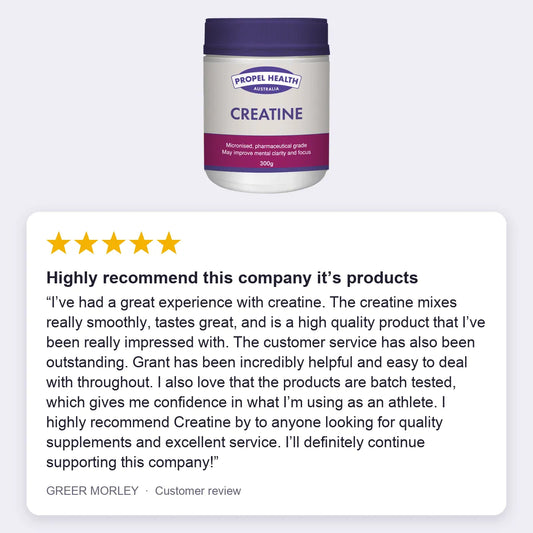
Propel Health Creatine Monohydrate is one ingredient: micronised creatine monohydrate, unflavoured, vegan and lab tested, in a 300 g tub.
For the serve, check the label on the tub.
It costs $0.67 a serve as a single tub, or $0.53 a serve in a 4 pack.
Buy Propel Health Creatine Monohydrate
References
- Kreider RB et al. International Society of Sports Nutrition position stand: safety and efficacy of creatine supplementation in exercise, sport, and medicine. Journal of the International Society of Sports Nutrition, 2017.