Sea Salt Trace Minerals vs Liquid Trace Minerals: Which Adds More to Your Water?
TL;DR: Sea salt trace minerals are real, but they come in tiny amounts alongside a lot of sodium. Sea salt is mostly sodium chloride, so a pinch in water adds salt first and trace minerals second. A liquid trace mineral complex adds minerals to water with almost no sodium. If the goal is minerals rather than seasoning, compare the sodium line on both labels.
A pinch of Celtic salt in the morning glass.
It is one of the most shared habits in natural health circles.
The idea is simple: unrefined salt carries trace minerals, so salted water is mineral water.
Here is what the numbers say.
What trace minerals are in sea salt?
Unrefined sea salts, including Celtic, grey and pink salts, keep small amounts of magnesium, potassium, calcium and other elements that refined table salt loses.
The catch is the proportion. Sea salt is still mostly sodium chloride, usually well over 90% by weight.
An Australian study of pink salt sold here (Fayet-Moore and colleagues, 2020) measured the minerals in dozens of samples. The amounts of other minerals were small, and getting a meaningful amount of them from salt would mean eating far more sodium than is recommended.
The sodium problem
The NHMRC's suggested dietary target for Australian adults is 2,000 mg of sodium a day. That is about 5 g of salt, a level teaspoon, from all food combined.
Most of us already pass that before we touch the salt shaker.
Your move: if you salt your water, count it as salt, not as a mineral supplement.
Sea salt vs liquid trace minerals, side by side
| Sea salt (Celtic, grey, pink) | Liquid trace mineral complex | |
|---|---|---|
| Main ingredient | Sodium chloride | Water with dissolved or suspended minerals |
| Trace minerals | Small amounts, varies by source | The reason it exists, varies by brand |
| Sodium per use | High (a pinch is roughly 150 to 300 mg) | Low, check the label |
| Taste in water | Salty | Mild, slightly earthy |
| Best used for | Seasoning food | Adding minerals to water |
When sea salt makes sense
Salt in water has a place. Endurance athletes in the heat lose sodium in sweat and often add some back.
That is a sodium decision, made on purpose. It is not a trace mineral plan.
When a liquid trace mineral complex makes sense
If you drink filtered water, or simply want minerals without the salt, a liquid trace mineral supplement does the job salt cannot.
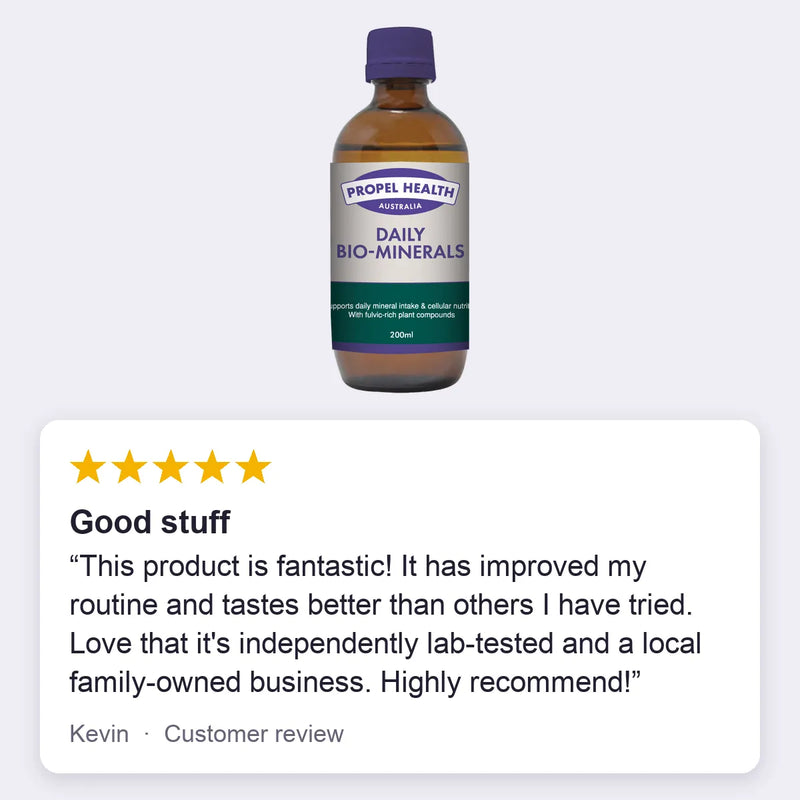
Propel Health's liquid trace mineral supplement, Daily Bio-Minerals, is organic colloidal trace minerals with fulvic and humic acids. The label serve is one tablespoon (15 mL) in water, once a day, with less than 1 mg of sodium per serve.
Using filtered water at home? Here is how to add minerals to filtered water.
Frequently asked questions
Is Celtic salt better than table salt for minerals?
It carries more trace minerals than refined salt, but still in small amounts next to its sodium. Use it for flavour, not as a mineral source.
Can I use sea salt and a trace mineral liquid together?
Yes. They do different jobs. Just keep your total daily sodium in mind.
How do I compare trace mineral products?
Read the ingredient list, the serve size and the sodium line. More on that in how to choose a fulvic acid supplement, or browse the mineral supplements collection.
References
Fayet-Moore F, et al. (2020). An analysis of the mineral composition of pink salt available in Australia. Foods 9(10):1490.
National Health and Medical Research Council (2006, updated 2017). Nutrient Reference Values for Australia and New Zealand: Sodium.
Propel Health Australia. Daily Bio-Minerals 500 mL printed label (2025).
About the author
Grant Jenkins is co-founder of Propel Health Australia, an Australian, family-owned company based in Brisbane, Queensland, and an ESSA Accredited Exercise Physiologist. Every Propel Health figure quoted here is the figure on the pack.
Disclaimer
This article is general information, not medical advice. Daily Bio-Minerals is a food, taken as part of a balanced diet. Speak to your healthcare provider before starting anything new, especially if you are pregnant, breastfeeding, take regular medication or are under medical supervision.